




1st Edition
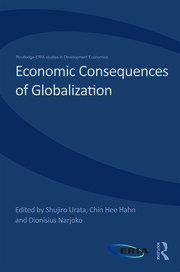
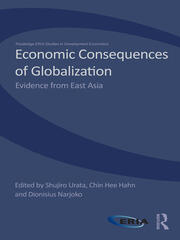
Economic Consequences of Globalization Evidence from East Asia
1. Introduction Shujiro Urata, Chin Hee Hahn and Dionisius Narjoko 2. Learning-by-Exporting in Korean Manufacturing: A Plant-Level Analysis Chin Hee Hahn and Chang-Gyun Park 3. Trade, Productivity and Innovation: The Case of Malaysia Cassey Lee Hong Kim 4. Does Trade Protection Improve Firm Productivity? Evidence from Philippine Micro Data Rafaelita Aldaba 5. Impact of Trade and Investment Liberalization on Productivity in Organized Manufacturing in India Ram Upendra Das 6. Policy Reforms, Firm Entry, and Labor Productivity Change: Learning from Vietnamese Manufacturing Dionisius Narjoko 7. The Source of Production, Employment and Productivity in Indonesia Haryo Aswicahyono and Teguh Yudo Wicaksono 8. Vertical and Horizontal FDI Technology Spillovers: Evidence from Thai Manufacturing Archanun Kohpaiboon 9. The Role of Market Potential in Location Choice: Evidence from Japanese Investment Toshiyuki Matsuura and Kazunobu Hayakawa 10. Import-as-Market Discipline Hypothesis: Evidence of Thai Manufacturing Sector Archanun Kohpaiboon
Biography
Shujiro Urata is Professor of Economics at Graduate School Asia-Pacific Studies, Waseda University, Faculty Fellow at the Research Institute of Economy, Trade and Industry, Research Fellow at the Japanese Centre for Economic Research, Senior Research Advisor, Economic Research Institute for ASEAN and East Asia (ERIA). Professor Urata received his Ph.D. in Economics from Stanford University. He specializes in international economics and has published a number of books and articles on international economic issues. His recent co-edited books include Bilateral Trade Agreements: Origins, evolution, and implications, Routledge, 2005, Multinationals and Economic Growth in East Asia, Routledge, 2006, Free Trade Agreements in the Asia-Pacific, World Scientific, 2010.
Chin Hee Hahn is Associate Professor at Department of Economics Gachon University. Until recently, he has worked as a Senior Fellow at Korea Development Institute (KDI), Adjunct Professor at KDI School of Public Policy and Management, Editor-in-Chief of an academic journal KDI Journal of Economic Policy. He has also served as Korea Country Coordinator of NBER-EASE (East Asia Seminar on Economics) and EADN (East Asia Development Network). Dr. Hahn received his Ph.D. in Economics from the University of Chicago. He specializes in growth and development and international trade, has published books and articles in related issue. His recent co-edited books include The Rise of China and Structural Changes in Korea and Asia, Edward Elgar, 2010, Economic Consequences of Globalization: Evidence from East Asia, Routlege, 2011 (forthcoming), Trade and Innovation in East Asia , ERIA, 2011, Responding to Climate Change: Global Experiences and the Korean Perspective, Edward Elgar, 2012 (forthcoming), Reforms for Korea’s Sustained Growth, KDI Press, 2011.
Dionisius Narjoko is a researcher at the Economic Research Institute for ASEAN and East Asia (ERIA). Dr. Narjoko received his Ph.D. in Economics from the Australian National University. His research concentrates on the topics related to industrial organization, international trade, and development economics, including industrialization. He has published some articles and book chapters on these, including the co-authored book Industrialisation after a Deep Economic Crisis: Indonesia, published in Journal of Development Studies, 2010, and Winners and Losers during Deep Economic Crisis: Firm-level Evidence from Indonesian Manufacturing, published in Asian Economic Journal, 2008.
