





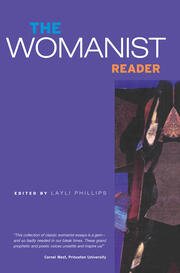
1st Edition
The Womanist Reader The First Quarter Century of Womanist Thought
Table of Contents
Dedication
Copyright Information
Acknowledgments
Introduction
Womanism: On Its Own, by Layli Phillips
Part 1 – Birthplaces, Birthmothers: Womanist Origins
Alice Walker’s Womanism
Coming Apart (1979), by Alice Walker
Gifts of Power: The Writings of Rebecca Jackson (1981), by Alice Walker
From In Search of Our Mothers’ Gardens: Womanist Prose (1983), by Alice Walker
Chikwenye Okonjo Ogunyemi’s African Womanism
Womanism: The Dynamics of the Contemporary Black Female Novel in English (1985), by Chikwenye Okonjo Ogunyemi
Clenora Hudson-Weems’s Africana Womanism
Cultural and Agenda Conflicts in Academia: Critical Issues in Africana Women’s Studies (1989), by Clenora Hudson-Weems
Africana Womanism (1993), by Clenora Hudson-Weems
Part 2 – Womanist Kinfolk: Sisters, Brothers, Daughters, and Sons on Womanism
Sisters and Brothers: Black Feminists on Womanism
What’s in a Name? Womanism, Black Feminism, and Beyond (1996), by Patricia Hill Collins
A Black Man’s Place in Black Feminist Criticism (1998), by Michael Awkward
Daughters and Sons: The Birth of Womanist Identity
Who’s Schooling Who? Black Women and the Bringing of the Everyday into Academe, or, Why We Started the Womanist (1995), by Layli Phillips & Barbara McCaskill
To Be Black, Male, and "Feminist": Making Womanist Space for Black Men (1997), by Gary L. Lemons
Part 3 – Womanist Theory & Praxis: Womanism in the Disciplines
Literature & Literary Criticism
Some Implications of Womanist Theory (1986), by Sherley Anne Williams
A Womanist Production of Truths: The Use of Myths in Amy Tan (1995), by Wenying Xu
Theology
Womanist Theology: Black Women’s Voices (1987), by Delores S. Williams
Christian Ethics and Theology in Womanist Perspective (1989), by Cheryl J. Sanders, Katie G. Cannon, Emilie M. Townes, Shawn M. Copeland, bell hooks, and Cheryl Townsend Gilkes
History
Womanist Consciousness: Maggie Lena Walker and the Independent Order of St. Luke (1989), by Elsa Barkley Brown
Theatre & Film Studies
Dialogic Modes of Representing Africa(s): Womanist Film (1991), by Mark A. Reid
Communication & Media Studies
A Womanist Looks at the Million Man March (1996), by Geneva Smitherman
Assessing Womanist Thought: The Rhetoric of Susan L. Taylor (2000), by Janice D. Hamlet
Psychology
Womanist Archetypal Psychology: A Model of Counseling Black Women and Couples Based on Yoruba Mythology (2005), by Kim Váz
Anthropology
Portraits of Mujeres Desjuiciadas: Womanist Pedagogies of the Everyday, the Mundane, and the Ordinary (2001), by Ruth Trinidad Galván
Education
Giving Voice: An Inclusive Model of Instruction – A Womanist Perspective (1994), by Vanessa Sheared
A Womanist Experience of Caring: Understanding the Pegagogy of Exemplary Black Women Teachers (2002), by Tamara Beauboeuf-Lafontant
Social Work
Elizabeth Ross Haynes: An African American Reformer of Consciousness, 1908-1940 (1997), by Iris Carlton-LaNey
Nursing Science
Womanist Ways of Knowing: Theoretical Considerations for Research with African American Women (2000), by JoAnne Banks-Wallace
Sexuality Studies
Kuaering Queer Theory: My Autocritography and a Race-Conscious, Womanist, Transnational Turn (2003), by Wenshu Lee
Architecture/Urban Studies
Critical Spatial Literacy: A Womanist Positionality and the Spatio-temporal Construction of Black Family Life (2004), by Epifania Akosua Amoo-Adare
Part 4 – Critiquing the Womanist Idea
The Language of Womanism: Rethinking Difference (1997), by Helen (charles)
Warrior Marks: Global Womanism’s Neo-colonial Discourse in a Multicultural Context (2001), by Inderpal Grewal & Caren Kaplan
Part 5 – Womanist Resources
A Womanist Bibliography (including Internet resources)
Index
Biography
Layli Phillips is Associate Professor of Women's Studies and an associate faculty member of the department of African-American Studies at Georgia State University. This is her first book.
"Long overdue, Layli Phillips' The Womanist Reader is a pioneering text that illuminates the genealogy of womanism and its complex meanings. Phillips' articulation of its connections with and departures from both ‘feminism’ and ‘black feminism’ is cogent and provocative. This anthology lays the groundwork for future scholarship on this little understood analytic construct, but critically important intervention in the broad project of social justice."
—Beverly Guy-Sheftall, editor of Words of Fire: An Anthology of African American Feminist Thought and Director of the Women's Center, Spelman College"Bringing together many groundbreaking articulations of womanist thought, Layli Philips has assembled a superb collection. The Womanist Reader is essential reading for womanists, feminists, activists, and scholars in many disciplines, including women’s studies, Africana studies, African-American Studies, ethnic studies, and American Studies."
—AnaLouise Keating, coeditor of this bridge we call home and Professor of Women’s Studies, Texas Woman's University"This important reader is a theoretical and methodological breakthrough in our understanding of womanist scholarship from a wide array of disciplines. This is essential reading that highlights the contributions of womanism to gender theory and praxis."
—Filomina Steady, editor of The Black Woman Cross-Culturally and Professor and Chair of Africana Studies, Wellesley College
"Layli Phillips' comprehensive anthology is a much-needed reader for today and for generations to come. The Womanist Reader chronicles twenty-five years of juxtapositioned insights and empowering revelations by womanists across the disciplines."
—Katie G. Cannon, author of Katie's Canon: Womanism and the Soul of the Black Community
