
1st Edition

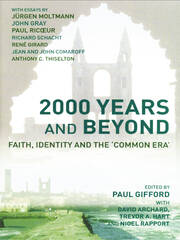
2000 Years and Beyond Faith, Identity and the 'Commmon Era'

240 Pages
by Routledge

240 Pages
by Routledge

240 Pages
by Routledge

2000 Years and Beyond brings together some of the most eminent thinkers of our time - specialists in philosophy, theology, anthropology and cultural theory. In a horizon-scanning work, they look backwards and forwards to explore what links us to the matrix of the Judaeo-Christian tradition from which Western cultural identity has evolved. Their plural reflections raise searching questions about... Read more
1. Volume introduction. 2000 Years: looking backwards and forwards Editors 2. Progress and Abyss: remembering the future in the modern world J. Moltmann, University of Tübingen 3. Liberalism and value-pluralism: a post-Enlightenment view J. Gray, LSE 4. History and the Representation of the Past P. Ricoeur, Ecole des Hautes Etudes, Paris 5. The Future of Human Nature R. Schacht, University of Illinois 6. Sacrifice in archaic culture, in Judaism and in Christianity René Girard, Stanford, California 7. 'Second Comings:Neo-Protestant Ethics and Millennial Capitalism in Africa and elsewhere' J and J Comaroff, Chicago 8. Theology and the postmodern mind A.Thiselton, University of Nottingham 9. Conclusion: Beyond 2000 Years _ _

Biography

Paul Gifford is Buchanan Professor of French and Director of the Institute of European Cultural Identity Studies at the University of St Andrews. His publications inclide Reading Paul Valéry: Universe in Mind (Cambridge, 1999) and Subject Matters: Subject and Self in French Literature from Descartes to the Present (Rodopi, 1999). David Archard, Trevor A. Hart and Nigel Rapport all teach at the University of St Andrews.

'This is a fascinating series of lectures given at St Andrews University, circling around the theme of whether the Christian era is over, and what might happen next ... Each lecture is short and readabe, and provides an excellent example of the author's thought.' - Keith Ward, Church Times

' ... sparkles with intellectual power and eloquence.' - The Journal of the Royal Anthropological Institute
