
Skip to Content

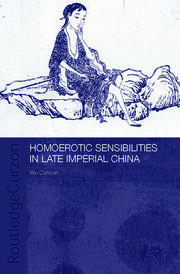
Homoerotic Sensibilities in Late Imperial China

By Wu Cuncun

Foreword by Chris Berry

Published August 12th 2004 by Routledge – 256 pages

Series: Routledge/Asian Studies Association of Australia (ASAA) East Asian Series

Purchasing Options:

Description

Homoerotic Sensibilities in Late Imperial China is the richest exploration to date of late imperial Chinese literati interest in male love. Employing primary sources such as miscellanies, poetry, fiction and 'flower guides', Wu Cuncun argues that male homoeroticism played a central role in the cultural life of late imperial Chinese literati elites. Countering recent arguments that homosexuality was marginal and disparaged during this period, the book also seeks to trace the relationship of homoeroticism to status and power.

In addition to historical portraits and analysis, the book also advances the concept of 'sensibilities' as a method for interpreting the complex range of homoerotic texts produced in late imperial China.

Contents

1. Introduction 2. Historical Origins of Qing Male Homoerotic Sensibilities 3. Class and Taste: The Literati as the Primary Location of Homosexual Sensibilities 4. Male-Romance in Vogue: From Qianlong to Tongzhi, 1736-1874 5. The Commericalisation of Male Love: The World of Boy-Actors 6. Conclusion Bibliographies Glossary Index

Author Bio

Wu Cuncun received her Ph.D in Chinese Studies from the University of Melbourne and now lectures in the School of Languages, Cultures and Linguistics at the University of New England, Australia. She has published widely on gender and sexuality and is the author of Ming Qing shehui xing'ai fengqi [Sex and Sensibility in Ming and Qing Society] (Beijing, 2000)

Name: Homoerotic Sensibilities in Late Imperial China (Hardback)Routledge 
Description: By Wu CuncunForeword by Chris Berry. Homoerotic Sensibilities in Late Imperial China is the richest exploration to date of late imperial Chinese literati interest in male love. Employing primary sources such as miscellanies, poetry, fiction and 'flower guides', Wu Cuncun...
Categories: Chinese Studies, Social & Cultural History, Historical Archaeological Theory
