





1st Edition
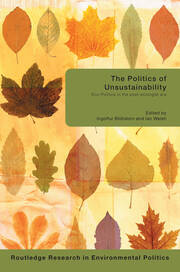
The Politics of Unsustainability Eco-Politics in the Post-Ecologist Era
216 Pages
by
Routledge
216 Pages
by
Routledge
215 Pages
by
Routledge
Also available as eBook on:
Two decades after its launch by the UN Brundtland Commission, the paradigm of sustainability seems to have reached its limits. Whilst the concept figures more prominently in public debate and policy making than ever before, the ecological footprint of advanced liberal consumer societies continues to grow, and the forceful economic development of countries such as China and India reinforces... Read more
- Eco-politics beyond the paradigm of sustainability: a conceptual framework and research agenda. Ingolfur Bluhdorn & Ian Welsh
- Changing public discourse on the environment: Danish media coverage of the Rio and Johannesburg UN summits. Lars Kjerulf Petersen
- Participation and sustainable development: The post-ecologist transformation of citizen involvement in Denmark. Jeppe Lassoe
- Sustaining the unsustainable: Symbolic politics and the politics of simulation. Ingolfur Bluhdorn
- Symbolic environmental legislation and societal self-deception. Jens Newig
- Sustainable development as symbolic commitment: Declaratory politics and the seductive appeal of ecological modernisation in the European Union. Susan Baker
- Dissolving the nation: Self-deception and symbiotic inversion in the GM debate. Emma Hughes
- The post-ecologist condition: irony as symptom and cure. Bronislaw Szerzynski
- In defence of civilisation: Terrorism and environmental politics in the 21st century. Ian Welsh
Biography
Ingolfur Blühdorn is Reader in Politics and Political Sociology at the University of Bath, UK. His work connects aspects of political sociology, social theory, eco-political theory and environmental sociology. He has published widely on social movements, Green Parties and processes of societal modernisation.
Ian Welsh is Reader in Sociology in the Cardiff School of Social Sciences. He has worked on the interface between science, environment and social movements. His most recent work addresses the social and political implications of complexity theory.
