
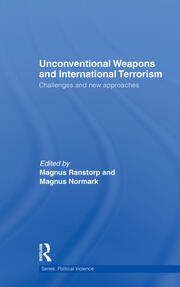
Unconventional Weapons and International Terrorism

Challenges and New Approaches

Edited by Magnus Ranstorp, Magnus Normark

  • Price: $140.00
  • Binding/Format: Hardback
  • ISBN: 978-0-415-48439-8
  • Publish Date: January 13th 2009
  • Imprint: Routledge
  • Pages: 212 pages

Series: Cass Series on Political Violence

Description

In recent years, senior policy officials have highlighted increased signs of convergence between terrorism and unconventional (CBRN) weapons. Terrorism now involves technologies available to anyone, anywhere, anytime, deployed through innovative solutions. This indicates a new and more complex global security environment with increasing risks of terrorists trying to acquire and deploy a CBRN (Chemical Biological Radiological Nuclear) attack.

This book addresses the critical importance of understanding innovation and decision-making between terrorist groups and unconventional weapons, and the difficulty in pinpointing what factors may drive violence escalation. It also underscores the necessity to understand the complex interaction between terrorist group dynamics and decision-making behaviour in relation to old and new technologies.

Unconventional Weapons and International Terrorism seeks to identify a set of early warnings and critical indicators for possible future terrorist efforts to acquire and utilize unconventional CBRN weapons as a means to pursue their goals. It also discusses the challenge for intelligence analysis in handling threat convergence in the context of globalisation. The book will be of great interest to students of terrorism studies, counter-terrorism, nuclear proliferation, security studies and IR in general.

Contents

Introduction – Magnus Ranstorp and Magnus Normark. Part I. The Status of CBRN Terrorism Research. Chapter 1: Defining Knowledge Gaps Within CBRN Terrorism Research - Gary Ackerman. Part II. AQ Motivations/Incentives for CBRN-Terrorism? Chapter 2: WMD and the Four Dimensions of Al-Qa’ida - Brian Fishman and James J.F. Forest. Chapter 3: Al-Qaeda’s thinking on CBRN: A case study – Anne Stenersen. Part III. CBRN, Capacity Building and Proliferation. Chapter 4: Indicators of Chemical Terrorism – Amy E. Smithson. Chapter 5: Capacity-building and Proliferation Biological Terrorism – Gabriele Kraatz-Wadsack. Chapter 6: Terrorism and Potential Biological Warfare Agents – Walter Biederbick. Chapter 7: Influence Diagram Analysis of Nuclear and Radiological Terrorism – Charles D. Ferguson. Part IV. CRBN and Terrorism: Dilemmas of Prediction? Chapter 8: Approaching Threat Convergence from an Intelligence Perspective – Gregory F. Treverton. Chapter 9: Terrifying Landscapes: Understanding Motivations of Non-State Actors to Acquire and/or Use Weapons of Mass Destruction – Nancy K Hayden. Chapter 10: Conclusions – Magnus Ranstorp and Magnus Normark

Author Bio

Magnus Ranstorp is Research Director at the Center for Asymmetric Threat Studies the Swedish National Defence College. Magnus Normark is a Research Analyst at the Division of CBRN Defence and Security at the Swedish Defence Research Agency.

 

Textbook Companion Websites

Many of our textbooks and course books have companion websites offering additional resources to educators and students. Learn more.

Find a Sales Representative

Are you looking for a local bookseller, sales representative or agent? You can view our global list of representatives to meet your needs and answer any questions.

FREE Shipping & Postage

Take advantage now with our free shipping & postage offer on all US orders over $35 and UK orders over £20. Learn more about our shipping costs.