
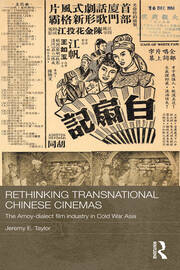
Rethinking Transnational Chinese Cinemas

The Amoy-dialect Film Industry in Cold War Asia

By Jeremy E. Taylor

  • Price: $150.00
  • Binding/Format: Hardback
  • ISBN: 978-0-415-49355-0
  • Publish Date: March 31st 2011
  • Imprint: Routledge
  • Pages: 192 pages

Series: Media, Culture and Social Change in Asia Series

Description

The Amoy-dialect film industry thrived in Hong Kong and Southeast Asia in the 1950s. Film in Amoy dialect, a dialect of Chinese, reflects a particular period in the history of the Chinese diaspora, and has been little studied due to its ambiguous place within the wider realm of Chinese and East Asian film history. This book represents the first full length, critical study of the origin, the significant rise and the rapid decline of the Amoy-dialect film industry in post-war Asia. Rather than examining the industry for its own sake, it focuses on its broader cultural, political and economic significance in the region. In particular, it questions many of the assumptions that are currently being made about the ‘recentness’ of transnationalism in Chinese cultural production, as well as the prominence given to ‘the nation’ and ‘nation-building’ in studies of Chinese cinemas and of the Chinese Diaspora. By examining a cinema that was not ‘national’, not grounded in any particular national tradition, and largely unconcerned with the ‘nation-building’ project in post-war Asia, this book challenges the very terms of reference within which many studies of film have been conducted.

Contents

@contents:1. Introduction. Defining the Amoy-dialect films; an industry remembered in the popular imagination in Southeast Asia but almost forgotten by scholars; the impossibility of ‘grounding’ this industry in debates about ‘national cinemas’ or ‘transnationalism’; what might the existence of this industry (and the academic silence about it) suggest as to the terms of reference of Chinese films studies today? 2. Context. The post-war Amoy-dialect Diaspora—definitions, geographic distribution, numbers and nature; why this is both a crucial group and a crucial period for understanding cultural production in East and Southeast Asia (and why both have not been widely studied before). 3. Origins. Revolution and displacement in southern China; the subsequent birth of Hong Kong’s ‘Little Fujian’; the survival and celebration of late-Republican Fujianese cultural production within the Amoy-dialect Diaspora; the development of Hokkien opera and getai performance in the post-war years. 4. Birth. The opera Amoy-dialect films of the mid-1950s and the move from amateur to commercial production; the role of Filipino Chinese investors and Amoy-dialect performers in Hong Kong’s ‘Little Fujian’. 5. The ‘new Amoy-dialect films’. The role of large-scale Singapore investment in expanding and changing the industry; the mass production of Amoy-dialect films and the influence of Mandarin and Cantonese cinema; the rise of ‘modern Hokkien songs’ and their links to the Amoy-dialect film industry; Amoy-dialect divas. 6. Colonies, ports and nations. Hong Kong as the centre of the Amoy-dialect world; the significance of the industry in the context of decolonisation in Malaya and Singapore; the industry’s celebration of colonial modernity in Hong Kong and rejection of postcolonial Chinese and Southeast Asian nationalisms. 7. Decline and forgetting. The industry’s collapse in the early 1960s; the dispersal of Amoy-dialect talent into ‘national cinemas’ and the Hong Kong film industry; the long-term academic ignorance of the industry and the recent rediscovery of the Amoy-dialect films in Fujian—the one part of the Amoy-dialect world which was itself cut off from the industry in its heyday. 8. Conclusion. Rethinking the role of the ‘transnational’ in Diasporic Chinese film history in light of this new material on the Amoy-dialect industry.

Author Bio

Jeremy E. Taylor is a lecturer in Chinese Studies at the School of East Asian Studies, University of Sheffield.


Textbook Companion Websites

Many of our textbooks and course books have companion websites offering additional resources to educators and students. Learn more.

Find a Sales Representative

Are you looking for a local bookseller, sales representative or agent? You can view our global list of representatives to meet your needs and answer any questions.

FREE Shipping & Postage

Take advantage now with our free shipping & postage offer on all US orders over $35 and UK orders over £20. Learn more about our shipping costs.
