
Skip to Content

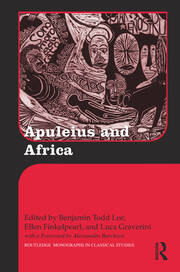
Apuleius and Africa

Edited by Benjamin Todd Lee, Ellen Finkelpearl, Luca Graverini

To Be Published June 30th 2013 by Routledge – 272 pages

Series: Routledge Monographs in Classical Studies

Purchasing Options:

  • Hardback: $125.00
    978-0-415-53309-6
    Not yet available

Description

The Metamorphoses or Golden Ass of Apuleius (ca. 170 CE) is a Latin novel written by a native of Madauros in Roman North Africa, roughly equal to modern Tunisia together with parts of Libya and Algeria. Apuleius’ novel is based on the model of a lost Greek novel; it narrates the adventures of a Greek character with a Roman name who spends the bulk of the novel transformed into an animal, traveling from Greece to Rome only to end his adventures in the capital city of the empire as a priest of the Egyptian goddess Isis. Apuleius’ Florida and Apology deal more explicitly with the African provenance and character of their author while also demonstrating his complex interaction with Greek, Roman, and local cultures. Apuleius’ philosophical works raise other questions about Greek vs. African and Roman cultural identity.

Apuleius in Africa addresses the problem of this intricate complex of different identities and its connection to Apuleius’ literary production. It especially emphasizes Apuleius’ African heritage, a heritage that has for the most part been either downplayed or even deplored by previous scholarship. The contributors include philologists, historians, and experts in material culture; among them are some of the most respected scholars in their fields. The chapters give due attention to all elements of Apuleius’ oeuvre, and break new ground both on the interpretation of Apuleius’ literary production and on the culture of the Roman Empire in the second century. The volume also includes a modern, sub-Saharan contribution in which "Africa" mainly means Mediterranean Africa.

Reviews

"With its original approach to the texts, this book once again proves that omnia iam vulgata does not apply to the study of the person Apuleius and his works. Carefully avoiding the pitfalls of mere "trendiness" by keeping the texts themselves as their anchor, the various authors prove that modern research into colonialism and post-colonialism may indeed throw fresh light on the study of a second-century Latin author living and working at the edges of the Roman Empire."Maaike Zimmerman, University of Groningen, The Netherlands

Contents

Introduction Ellen Finkelpearl, Luca Graverini, and Benjamin Lee Part I: The Cultural Context 1. The Apology of Apuleius: Text and Context Keith Bradley 2. Apuleius and Beyond: Constructing Identity in Second-Century Africa David Stone 3. The Survival of Apuleius: A Case for the African Connection Julia Gaisser 4. A.V.: Apuleius and the Logic of Post-Colonialism Benjamin Lee Part II: Different Identities 5. Authority and Subjectivity in the Apology Carlos Norena 6. Apuleius’ Response to Fronto’s Dream Career in Rome Wytse Keulen 7. The Negotiation of Provincial Identity: Apuleius and Virgil Luca Graverini 8. Prosthetic Origins: African and Platonic Identity in Apuleius Richard Fletcher 9. Apuleius and Afro-Asiatic Poetics Daniel Selden Part III: Post-Colonialism and Beyond 10. Provincial and Colonial Apuleius Alessandro Barchiesi 11. Procul a nobis: Apuleius and India Sonia Sabnis 12. Education and Authority in a (Post)-Colonial Context Roshan Abraham 13. Apuleius as Canonical Author Joseph Farrell 14. The Use of Animal Tales in Apuleius’ Metamorphoses and in the Contemporary Zimbabwean Novel Madhlozi Moyo

Author Bio

Benjamin Todd Lee is Associate Professor of Classics at Oberlin College.

Ellen Finkelpearl is Helen Chandler Garland Professor of Ancient Studies and Professor of Classics at Scripps College.

Luca Graverini is Ricercatore in the Department of Classics at the University of Siena, Arezzo.

Name: Apuleius and Africa (Hardback)Routledge 
Description: Edited by Benjamin Todd Lee, Ellen Finkelpearl, Luca Graverini. The Metamorphoses or Golden Ass of Apuleius (ca. 170 CE) is a Latin novel written by a native of Madauros in Roman North Africa, roughly equal to modern Tunisia together with parts of Libya and Algeria. Apuleius’ novel is based on the model of...
Categories: Latin Literature, Literature & Culture, African Literature, Literature & Race, Literary/Critical Theory, Classical Literature, Literary History
