





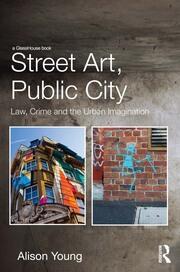
1st Edition
Street Art, Public City Law, Crime and the Urban Imagination
Chapter 1 The Situational Artwork; encounter watching JR, Chapter 2 The Cities in the City; encounter criminal damage?, Chapter 3 Cityscapes; encounter losing the image, Chapter 4 Criminalising the Image; encounter things on walls, Chapter 5 Street Art and Spatial Politics; encounter Banksy under glass, Chapter 6 Transformations: Urban Imagination in the Public City, Bibliography, Index
Biography
Alison Young is a Professor of Criminology in the School of Social and Political Sciences at the University of Melbourne.
‘My favourite criminologist in the world’
- Banksy
‘Street art is an elusive, complex subject, subject to misinformation and much prejudice. Alison Young offers readers a brilliant rigorous analysis, giving a comprehensive account of street art as a global phenomenon, and the tensions it frequently engenders in the control of public and private space, and the licit and illicit behaviour of artists who choose to stay away from the over-managed space of the museum or gallery.’
- Sandy Nairne, Director, National Portrait Gallery, London
‘From graffiti to "guerrilla knitting", political "pieces" to place-making "paste-ups", the various homologies and diverse characteristics of contemporary street art can seem bewildering, even to the most hard-bitten of urbanites. This sharp, stylish book provides a reliable and theoretically informed route map that, not only demystifies the genre, but also poses some important questions about street art’s democratic and political potential. Alison Young proves to be a most thoughtful and engaging tour guide as she takes us on a fascinating excursion across the contours of the international urban art scene and deep into the subterranean and ever-evolving world of today’s street artists. Whatever your feelings about graffiti, tagging, and other forms of urban mark-making, this book, just like the very best examples of street art, will challenge your preconceptions and make you think more deeply about the affects and effects of the twenty-first century’s most controversial art form.’
- Keith Hayward, Professor of Criminology, University of Kent, UK
‘Alison Young's Street Art, Public City is an indispensable sociology of street art, guiding the reader through the streets of many of the world's major cities. Brilliantly intertwining the disciplines of aesthetics, urbanism and legal theory, it paints a rich and compelling picture of the contemporary urban landscape, subtly bringing into focus a vital dimension of public culture.’
- Professor Jill Bennett, University of New South Wales, Australia
'Alison Young offers an intelligent and engaging account of her experiences as ‘a spectator to and researcher of street art’ (p. 9) drawing on ‘two decades looking at art on city walls’'
- Andrew Millie, Department of Law and Criminology, Edge Hill University, UK
"Notwithstanding her cursory consideration of graffiti, Young does an excellent job speaking to transgressive urban interventionism by way of her spatially conscious discussion of the act, aesthetic and legal response to art produced and placed in the public sphere. She accomplishes this not by analysing street art and its practitioners from an anthropological or sociological perspective, but by positioning street artwork as a ‘spatial object’ (p. 127) placed within the physical and ideological context of the city."
-Stefano Bloch, Brown University, USA, Urban Studies Journal
