
Skip to Content

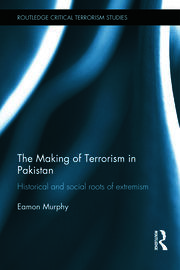
The Making of Terrorism in Pakistan

Historical and Social Roots of Extremism

By Eamon Murphy

To Be Published December 1st 2012 by Routledge – 224 pages

Series: Routledge Critical Terrorism Studies

Purchasing Options:

  • Hardback: 978-0-415-56526-4: $130.00
    Not Yet Available
  • eBook: 978-0-203-86169-1:
    Not Yet Available

Description

This book aims to explain the rise of Pakistan as a centre of Islamic extremism by going back to the roots of the state and the nature of Islam in Pakistan. The broad aim therefore is to examine the social, and political and economic factors that have contributed to the rise of terrorism in Pakistan.

An historical approach demonstrates how religion per se has not been the dominant factor in the rise of terrorism in Pakistan. Most Pakistanis have not in the past been susceptible to Islamic extremism; rather, religion has been largely a cloak to hide the individual and class interests of the elite, who have promoted, nurtured and supported religious extremism to advance their personal and class interests. In this sense, then, terrorism in Pakistan has been manufactured because of more mundane political and class interests. A logical consequence of this argument is that the most effective way of combating terrorism in Pakistan lies in addressing the underlying political, social and economic problems facing the country. Three major themes emerge from this historical exploration of the roots of religious extremism and terrorism: the dominant role of the Pakistani military in politics, economics and society and the directly related near failure of democracy; the key role that the USA has played, particularly with its support for military dictatorships; and, finally, and perhaps most important, the malignant influence of Saudi Arabia and its promotion of the narrow extremist Wahhabi form of Islam. Each of these factors has been intertwined and interrelated, and have all contributed to the decline of democracy and the emergence of terrorism. The author explores the root causes of terrorism in Pakistan, going back to political developments during the 1930s and 1940s that led to the formation of Pakistan, and then the subsequent history of Pakistan to the present day. In particular, it focuses on how the state itself created conditions that were conducive to the rise of terrorism. In so doing, this approach will analyze the class nature of Pakistani society and the failure of democracy to take strong roots in that society.

This is the first book to employ a Critical Terrorism Studies (CTS) approach to explain the origins and nature of terrorism in Pakistan. It will be of great interest to students of Critical Terrorism Studies, Asian Politics, Security Studies and IR in general.

Contents

Part 1: Islam, the Formation of Pakistan, and the First Military Dictatorship, 1947-69 1. A Clash of Civilizations? Islam in Pakistan 2. A Dream of a Secular, Inclusive, Democratic State Lost: Mohammed Ali Jinnah and the Formation of Pakistan 3. Class, Ethnicity and the Establishment of the New State 4. Enduring Conflict: The Kashmir Conflict and Ongoing Wars with India Part 2: On the Path to Islamization, 1969-98 5. Disaster: The Break-up of Pakistan and the Treat to the Sate’s Srvival 6. A Lost Opportunity: The Failure of Democracy under Zulfikar Ali Bhutto 7. On the Path to Global Terrorism: Islamization under General Zia ul-Haq 8. A Crucible for Terrorism: Afghanistan jihad and the Roles of the US and Saudi Arabia 9. Saudi Arabia and the Spread of Wahhabi Islam in Pakistan 10. Saviour or Failure? General Pervez Musharraf and the War on Terrorism 11. The Acid Test: 9/11 and the War on Terrorism Part 3: Pakistan Jihad and the Emergence of Global Terrorism, 1998-2009 12. A Turning Point? Descent into Chaos or the Restoration of Democracy and the Defeat of Terrorism. Conclusion: The Making of Terrorism

Name: The Making of Terrorism in Pakistan: Historical and Social Roots of Extremism (Hardback)Routledge 
Description: By Eamon Murphy. This book aims to explain the rise of Pakistan as a centre of Islamic extremism by going back to the roots of the state and the nature of Islam in Pakistan. The broad aim therefore is to examine the social, and political and economic factors that have...
Categories: Security Studies - Military & Strategic, Terrorism, South Asian Politics, Security Studies - Pol & Intl Relns, South Asian Studies, War & Conflict Studies, Critical Security, International Security, Terrorism & Political Violence, Regional Security
