




1st Edition
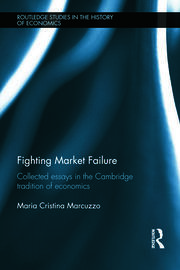
Fighting Market Failure Collected Essays in the Cambridge Tradition of Economics
Introduction Part 1: Individuals 1. Cambridge as a Place in Economics with Nerio Naldi, Annalisa Rosselli and Eleonora Sanfilippo 2. Keynes and Cambridge 3. Piero Sraffa at the University of Cambridge 4. The ‘Elusive Figure Who Hides in the Preface of Cambridge Books’: An Appraisal of Richard Kahn’s Contributions 5. Joan Robinson and the Three Cambridge Revolutions 6. R.F. Kahn and Imperfect Competition Part 2: Collaboration 7. The Collaboration between J.M. Keynes and R.F. Kahn from the Treatise to the General Theory 8. Joan Robinson and Richard Kahn: The Origin of Short-Period Analysis 9. Robinson and Sraffa 10. Sraffa and Cambridge Economics, 1928–1931 Part 3: Approach 11. From Market ‘Imperfections’ to Market ‘Failures’: Some Cambridge Challenges to Laissez-Faire 12. Alternative Microeconomic Foundations for Macroeconomics: The Controversy over the L-shaped Cost Curve Revisited 13. Short-Period Economics in Retrospect 14. The ‘First’ Imperfect Competition Revolution 15. Profit Maximization in the Cambridge Tradition of Economics with Eleonora Sanfilippo
Biography
Maria Cristina Marcuzzo is Professor in Economics at the University of Rome, "La Sapienza", Italy. She is Past President of the European Society for the History of Economic Thought, member of the Executive Committee of the Italian Society of Economists, and of the History of Political Economy Society.
"A must for all those interested in the Cambridge traditions of economics. Marcuzzo paints a rich and fascinating picture of their leading scholars and main ideas. She rightly rejects the view that there was a "Cambridge school"." - Heinz Kurz, University of Graz, Austria
"No surprise if, put together, these essays also contribute to give a better understanding and a clearer view of the “unconventional” lives these economists lived (part I), of the richness of their collaborations (part II), and of their ideas (part III). Indeed, each chapter provides, especially for a non-specialist like me, a lot of valuable information." - Alain Marciano, University of Montpellier
