
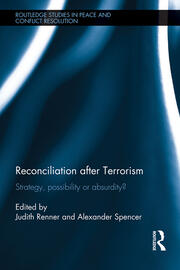
Reconciliation after Terrorism

Strategy, Possibility or Absurdity?

Edited by Alexander Spencer, Judith Renner

  • Price: $120.00
  • Binding/Format: Hardback
  • ISBN: 978-0-415-58858-4
  • Publish Date: March 31st 2011
  • Imprint: Routledge
  • Pages: 240 pages

Series: Routledge Studies in Peace and Conflict Resolution

Description

This book brings together scholars from the hitherto disparate fields of terrorism and reconciliation studies, to examine whether reconciliation is a possible strategy for dealing with and ending a terrorist conflict.

Traditionally, terrorism research has revolved around such questions as: What is terrorism? What causes it? How can it be dealt with? Reconciliation research tries to find ways to overcome deep societal rifts after civil conflict, to deal with injustices and to re-establish social and political peace and stability. The central questions raised here are: (a) what constitutes ‘reconciliation’ as a process and an outcome; and (b) how can reconciliation be facilitated in a situation of social conflict. All these questions play a part in the idea of reconciliation with ‘terrorists’. Reconciliation efforts are taken into consideration after state terror but not usually in situations of conflict with sub-state terrorist actors. Similar to state terror, sub-state terrorism is a sign of a deep societal rift which reconciliation measures may help to overcome. In addition, even though terrorist activities often play a role in situations of conflict and transition, ‘terrorists’ are generally not taken into consideration as active, or relevant, participants by researchers and practitioners. In some cases, the ‘terrorists’ turn into political actors during the reconciliation process and their past is not an issue anymore, as it was the case with the ANC in South Africa. In other cases terrorist groups are considered as spoilers of reconciliation and are therefore excluded from the societal reconciliation process, as was the case with ETA in Spain.

This book will be of much interest to students of terrorism studies, transitional justice, conflict resolution, peace and conflict studies and IR in general.

Contents

Introduction: Reconciling the Seemingly Irreconcilable? Judith Renner and Alexander Spencer Part 1: Theory and Methodology 1. A Reconciliation Perspective: Dealing with a Terrorist Past Michael Humphrey 2. A Terrorism Perspective: Actor Transformation of the ‘Terrorist’: Shades of Legitimacy TBC 3. Talking to Terrorists: Problems of Methodology and Risks of Field Research Carolin Görzig Part 2: Empirical Case Studies 4. Reconciliation without the Other: Germany and RAF Terrorism Christopher Daase 5. Reconciliation and the Failure of Terrorism in South Tyrol Günther Pallaver 6. Reconciliation and Paramilitaries in Northern Ireland Marie Breen Smyth 7. From Franco to ETA: Reconciliation after State and Sub-State Terror in Spain Andrew Rigby 8. From ‘Terrorist’ to Politicians: The ANC and Reconciliation in South Africa David J. Whittaker 9. Overcoming Terrorism without Reconciliation in Peru David Scott Palmer 10. Reconciliation with FARC in Colombia Juan Munévar and Frédéric Massé 11. Terror, Empathy and Reconciliation In the Israeli-Palestinian Conflict Yehudith Auerbach and Ifat Maoz Conclusion: From Isolation, via Negotiation to Reconciliation? Judith Renner and Alexander Spencer


Textbook Companion Websites

Many of our textbooks and course books have companion websites offering additional resources to educators and students. Learn more.

Find a Sales Representative

Are you looking for a local bookseller, sales representative or agent? You can view our global list of representatives to meet your needs and answer any questions.

FREE Shipping & Postage

Take advantage now with our free shipping & postage offer on all US orders over $35 and UK orders over £20. Learn more about our shipping costs.
