





1st Edition
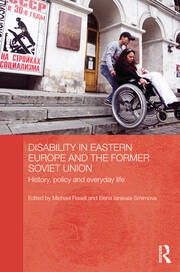
Disability in Eastern Europe and the Former Soviet Union History, policy and everyday life
Introduction: Conceptualising Disability in Eastern Europe and the Former Soviet Union Michael Rasell and Elena Iarskaia-Smirnova 1. Soviet Style Welfare: The disabled soldiers of the Great Patriotic War Beate Fieseler 2. Prosthetic Promise and Potemkin Limbs in Late-Stalinist Russia Frances Bernstein 3. Heroes and Spongers: The iconography of disability in Soviet poster and film Elena Iarskaia-Smirnova and Pavel Romanov 4. Between Disabling Disorders and Mundane Nervousness: Representations of psychiatric patients and their distress in soviet and post-soviet Latvia Agita Luse and Daiga Kamerade 5. Living with a Disability in Hungary: Reconstructing the narratives of disabled students Eszter Gábor 6. Citizens or ‘Dead Souls?’ An anthropological perspective on disability and citizenship in post-Soviet Ukraine Sarah Phillips 7. Breaking the Silence: Disability and sexuality in contemporary Bulgaria Teodor Mladenov 8. ‘Those who do not Work Shall not Eat!’ A comparative perspective on the ideology of work within Eastern European disability discourses Darja Zaviršek 9. The Challenges of Operationalizing a Human Rights Approach to Disability in Central Asia Hisayo Katsui 10. The Complex Role of Non-governmental Organisations in the Advancing the Inclusion of Children with Disabilities in Bosnia-Herzegovina and Bulgaria Majda Becirevic and Monica Dowling 11. Lost in Transition: Missed opportunities for reforming disabled children’s education in Armenia, Azerbaijan and Georgia Viktoria Shmidt
Biography
Michael Rasell is a Senior Lecturer in the School of Health and Social Care at the University of Lincoln, UK.
Elena Iarskaia-Smirnova is a Professor in the Department of General Sociology at the Higher School of Economics, Moscow, Russia.
