





1st Edition
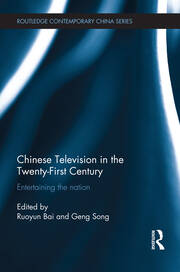
Chinese Television in the Twenty-First Century Entertaining the Nation
Introduction, Ruoyun Bai and Geng Song Part I: Entertaining TV - A New Territory of Significance 1, Teaching People How to Live: Shenghuo Programs on Chinese Television, Wanning Sun 2. "The New Family Mediator": TV Mediation Programs in China’s "Harmonious Society", Shuyu Kong and Colin S. Howes 3. The Long Commute: Mobile Television and the Seamless Social, Joshua Neves Part II: "Curbing Entertainment" 4. "Clean Up the Screen": Regulating Television Entertainment in the 2000’s, Ruoyun Bai 5. Rethinking Censorship in China—The Case of Snail House, How Wee Ng Part III: Commercial Television and the Reconfiguration of History, Memory, and Nationalism 6. Imagining the Other: Foreigners on the Chinese TV Screen, Geng Song 7. When Foreigners Perform the Chinese Nation: Televised Global Chinese Language Competitions, Lauren Gorfinkel and Andrew Chubb 8. Make the Present Serve the Past: Restaging On Guard beneath the Neon Lights in Contemporary China, Rong Cai 9. Remoulding Heroes: The Erasure of Class Discourse in the Red Classics Television Drama Adaptation, Qian Gong 10. Tianxia Revisited: Family and Empire on the Television Screen, Kun Qian
Biography
Ruoyun Bai is Assistant Professor in the Department of Arts, Culture, and Media and Centre of Comparative Literature at the University of Toronto, Canada.
Geng Song is Associate Professor in the School of Chinese at the University of Hong Kong.
Contributors used various techniques―textual analysis, interviews, correspondence--to gather data, and they support their arguments with interesting examples of particular shows, copious endnotes, and full bibliographies. - J. A. Lent, independent scholar
