
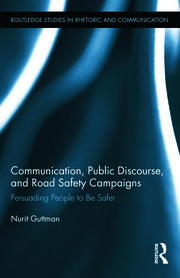
Communication, Public Discourse, and Road Safety Campaigns
Persuading People to Be Safer
By Nurit Guttman
To Be Published August 31st 2013 by Routledge – 228 pages
This book discusses the use of communication campaigns to promote road safety, arguing that they need to elicit public discourse on issues pertaining to culture, equity, gender, workplace norms, environmental issues, and social solidarity. Increasingly, new media channels and formats are employed in the dissemination process, making road safety-related messages ubiquitous, and often controversial. Policy makers, educators, researchers, and the public continue to debate the utility and morality of some of the influence tactics employed in these messages, such as the use of graphic images of injury or death, stigmatization (or "blame and shame"), and the use of "black humor." Guttman argues that influencing road safety requires making changes in normative and cultural conceptions of broader issues in society, yet the typical discourse on road safety tends to focus on individual attitudes and practices. The book regards the importance of theory in communication campaigns on road safety, and critiques that fact that they tend to focus on individual cognition, affect, and behavior rather than on structural and cultural factors. The volume positions the discourse on road safety as a social issue, and treats road safety behavior as a social activity that directly relates to other public issues, social values, and social policy, discussing potential uses of social media and participatory approaches. The discussion turns to the role of road safety communication campaigns as part of a democratic process of eliciting public discourse, including how contemporary society could address broader issues of risk and safety.
1. Introduction: The Social Context of Road Safety Communication Campaigns 2. Appealing to Reason and Cognition 3. Using Injury and Death to Influence Attitudes and Behavior 4. Threats of Legal Consequences 5. Appeals to Responsibility, Blame and Shame 6. Appeals to Positive Social Norms and Rewards 7. Modeling Positive Behaviors and Practical Suggestions 8. Beyond Scaring and Admonishing: Reframing the Social Role of Road Safety Campaigns
Nurit Guttman is the chair of the Department of Communication and head of the Herzog Institute for Media, Politics and Society at Tel Aviv University, Israel.
Name: Communication, Public Discourse, and Road Safety Campaigns: Persuading People to Be Safer (Hardback) – Routledge
Description: By Nurit Guttman. This book discusses the use of communication campaigns to promote road safety, arguing that they need to elicit public discourse on issues pertaining to culture, equity, gender, workplace norms, environmental issues, and social solidarity. Increasingly,...
Categories: Risk Communication, Rhetoric, Urban Communications & Technology, Communication Studies
