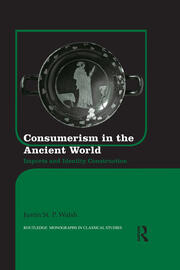
Greek pottery was exported around the ancient world in vast quantities over a period of several centuries. This book focuses on the Greek pottery consumed by people in the western Mediterranean and trans-Alpine Europe from 800-300 BCE, attempting to understand the distribution of vases, and particularly the reasons why people who were not Greek decided to acquire them. This new approach includes...
Read moreGreek pottery was exported around the ancient world in vast quantities over a period of several centuries. This book focuses on the Greek pottery consumed by people in the western Mediterranean and trans-Alpine Europe from 800-300 BCE, attempting to understand the distribution of vases, and particularly the reasons why people who were not Greek decided to acquire them. This new approach includes discussion of the ways in which objects take on different meanings in new contexts, the linkages between the consumption of goods and identity construction, and the utility of objects for signaling positive information about their owners to their community. The study includes a database of almost 24,000 artifacts from more than 230 sites in Portugal, Spain, France, Switzerland, and Germany. This data was mapped and analyzed using geostatistical techniques to reveal different patterns of consumption in different places and at different times. The development of the new approaches explored in this book has resulted in a shift away from reliance on the preserved fragments of ancient Greek authors’ descriptions of western Europe, remains of monumental buildings, and major artworks, and toward investigation of social life and more prosaic forms of material culture.
ADDITIONAL E-RESOURCES FOR THIS BOOK ARE AVAILABLE: https://digitalcommons.chapman.edu/art_data/1/
Read less