





1st Edition
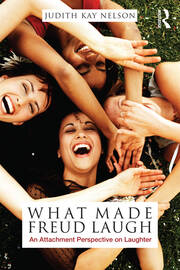
What Made Freud Laugh An Attachment Perspective on Laughter
Biography
Judith Kay Nelson, MSW, PhD, is the former Dean and currently on the faculty of The Sanville Institute for Clinical Social Work and Psychotherapy, California. She also teaches attachment and neurobiology in the clinical social work doctoral program at Smith College, Massachusetts. She has taught and presented throughout the United States and Europe on topics related to crying, grief, laughter and attachment.
“This is a wonderful, insightful, and beautifully written book! It takes attachment theory in new directions and suggests valuable ideas for research on parent-child and couple relationships. It sheds a warm light on the positive side of emotional life and loving relationships.” – Phillip R. Shaver, PhD, Distinguished Professor of Psychology, UC Davis; coeditor, Handbook of Attachment: Theory, Research, and Clinical Applications; Past President, International Association for Relationship Research
“Judith Nelson, a skilled clinician and accomplished attachment researcher, has written a creative, scholarly and clinically relevant magnum opus on laughter. On all levels, this book is a joy to read.” – Allan N. Schore, PhD, UCLA David Geffen School of Medicine
“Judith Kay Nelson’s exciting treatment of laughter as a crucially human attachment transaction opens up broad new avenues for clinical analysis and research inquiry. She has with great sensitivity woven together wisdom from neuroscience to ethology, from psychology to literature, subtly weaving light notes of humor amongst deep considerations of the human condition. Therapists and researchers alike will thank Nelson for her inspiring treatment of laughter.” – Catherine Ann Cameron, PhD, Honorary Professor of Psychology, University of British Columbia, Canada
"What is so impressive about this book is that it manages, within its 200-plus pages, to be comprehensive, detailed, lively and illustrated throughout with clinical material and family anecdotes as well as evidence from research. ... This book has wide relevance - learning to be more aware of this aspect of non-verbal communication would be helpful for clinicians of all theoretical approaches. It is also fascinating to look in such close focus at a feature of human behaviour that is so rarely scrutinised." - Mary Neave, Therapy Today (June 2013)
