




1st Edition
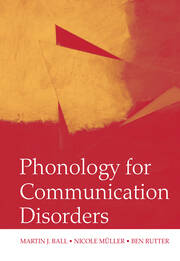
Phonology for Communication Disorders
Introduction. 1. Introduction and Background. 2. Sonority Theory. 3. Distinctive Features. 4. Early Generative Phonology. 5. Developments with Features. 6. Developments with Derivations: Lexical and Prosodic Phonology. 7. Autosegmental Phonology. 8. Metrical Phonology. 9. Prosodic Analysis. 10. Natural Phonology. 11. Optimality Theory. 12. Articulatory Phonology. 13. Government Phonology. 14. Cognitive, Systemic and Grounded Phonologies. 15. Clinical Phonology. Answers to Exercises. Charts. Index.
Biography
Martin J. Ball, Nicole Muller, Ben Rutter
"For students and teachers of clinical phonology and researchers [this] is a very useful book which provides an excellent review of the various theoretical frameworks to the analysis of speech disorders." - Ciara O'Toole, University College Cork, Ireland, in the International Phonetic Association
"Unlike many of the original works in linguistic phonology, this book is an absolute pleasure to read. The writing is engaging and concise, and the argument is very clear and structured. Concepts are illustrated with well-chosen examples, and the frequent references to clinical applications bring the subject to life for speech-language pathologists. This clarification does not result in simplification or dumbing down of the subject, and the author uses exercises and study questions to challenge the reader to actively digest the materials presented. The critical commentary for each of the phonological theories is measured and well balanced. The authors’ own enthusiasm for phonology and its clinical application comes through in their own writing." - Tim Bressmann, University of Toronto, in Canadian Journal of Speech-Language Pathology and Audiology
"The writing style provides a clear portrayal of the theoretical concepts. It would be most valuable for students or practitioners of speech-language pathology." - Helen Henshaw, National Biomedical Research Unit in Hearing, University of Nottingham, in The Psychologist
