
1st Edition

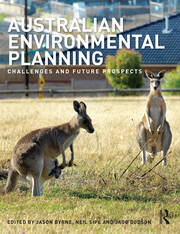
Australian Environmental Planning Challenges and Future Prospects

Edited By Jason Byrne, Neil Sipe, Jago Dodson Copyright 2014
292 Pages
by Routledge

292 Pages
by Routledge

292 Pages
by Routledge

Winner of the Planning Institute of Australia's 2015 Cutting Edge Research and Teaching Award! Australians from all walks of life have begun to realise the nation’s cities cannot sustain profligate growth indefinitely. Dwindling water supplies, failing food bowls, increased energy costs, more severe bushfires, severe storms, flooding, coastal erosion, rising transport expenses, housing... Read more
PREFACE (by Professor Ian Douglas - Co-Chairman, UNESCO SCOPE Expert Group on Urban Futures) DEDICATION (To the First Nation Peoples / Traditional Custodians of Australia) Table of Contents Table of Figures Tables 1. INTRODUCTION 1. What is environmental planning? – Byrne, Sipe and Dodson 2. Indigenous relationships to ‘country’ & planning with Native Title – Wensing 3. Australian environmental planning origins and theory/ies – Freestone 2. GOVERNING AUSTRALIAN ENVIRONMENTAL PLANNING 4. The legal basis for Australian environmental planning & governance – England 5. Australian environmental governance and environmental planning procedures – Steele and MacCallum 3. THE URBAN ENVIRONMENT AND ITS CHALLENGES 6. Land use and land management – Garrard and Bekessey 7. Water use and water management – Syme 8. Air quality and pollution management – Chan and Byrne 9. Urban vegetation – Wang, Amati and Byrne 10. Urban wildlife – Daniels and Roetman 4. URBAN ENVIRONMENTAL PROCESSES 11. Energy generation, planning and management – Foran 12. Transportation planning – Sipe 13. Industrial ecology – Roberts 5. KEY AGENDAS IN MANAGING ENVIRONMENTAL CHANGE 14. Sustainable and affordable housing – Bosman and Dodson 15. Healthy cities – Giles-Corti, Badland, Foster, Mavoa, Whitzman and Turrell 16. Participatory democracy, community building and social inclusion – Cameron and Grant-Smith 17. Environmental equity/justice – Byrne and Houston 6. CONCLUSION: NEW DIRECTIONS AND POTENTIALITIES 18. Green urbanism – Lehmann and John 19. Bioregional planning and growth management – Dedekorkut-Howes 20. Positive development – Birkeland Epilogue – Byrne, Dodson and Sipe Index

Biography

Jason Byrne is a Senior Lecturer in Urban and Environmental Planning in the Griffith School of Environment, Griffith University, Gold Coast campus, where he has taught since 2006. A geographer, anthropologist and planner by training, Jason’s research interests include: urban nature, parks, green-space, environmental justice and political ecology. Jason previously worked as a planning officer, environmental officer and policy writer with the Western Australian government.

Jago Dodson is Director of the Urban Research Program at Griffith University, Brisbane. Jago has applied his background in anthropology and urban planning to a raft of urban problems and questions, often with a social or institutional dimension. These include housing, transport and metropolitan planning. Jago teaches a course on Understanding the Australian City in the Urban and Environmental Planning program at Griffith. He has published widely in both academic and public venues.

Neil Sipe is the deputy director of the Urban Research Program at Griffith University. He currently serves on the Transportation Research Board Ferry Committee and the Social and Economic Effects of Transportation Committee and is the editor of the peer reviewed journal Australian Planner.

"[T]he range and great relevance of topics presented make this a very important new resource in urban planning."Geographical Education, Professor Rob Wallis Federation University Australia
