





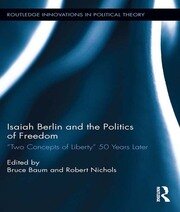
1st Edition
Isaiah Berlin and the Politics of Freedom ‘Two Concepts of Liberty’ 50 Years Later
Introduction: Berlin and the Politics of Freedom Part I: Berlin in Context 1. "Two Concepts of Liberty" in Context; James Tully 2. In Defense of Berlin: A Reply to James Tully; George Crowder Part II: Rethinking "Positive" and "Negative" Freedom 3. Defending Isaiah Berlin´s Distinctions between Negative and Positive Freedoms; Maria Dimova-Cookson. 4. Freedom, Autonomy, and Social Selves; John Christman 5. Retrieving Positive Freedom and Why It Matters; Carol C. Gould 6. Republicanism and the Market in "Two Concepts of Liberty"; Eric MacGilvray Part III: Democratic Pluralism and National Self-Determination 7. Berlin and Democracy; Ella Myers 8. Making Sense of Negative Liberty: Berlin’s Antidote to Political Rationalism; Melissa Orlie 9. Berlin, Tagore and the Legitimacy of Nationalism; Partha Chatterjee Part IV: Berlin and Critical Theories of Freedom 10. Berlin, Feminism, and Positive Liberty; Nancy Hirschmann 11. From Rationalism to Micro-power: Freedom and its Enemies; Diana Coole 12. The World of Negative Liberty: Reading Isaiah Berlin through Weak Ontology; Robert Nichols 13. Critical Theory, Ecology, and "What´s Wrong With Negative Liberty"; Bruce Baum
Biography
Bruce Baum is Associate Professor of Political Science at the University of British Columbia, Canada.
Robert Nichols is Assistant Professor in the Departments of Philosophy and Political Science at the University of Alberta, Canada.
"What is appealing about this book is the way in which it brings Berlin’s essay squarely into the context of contemporary debates in political philosophy. Whether they are admirers or critics (or both), the authors in this collection show how Berlin’s essay speaks to contemporary debates involving issues such as feminism and republicanism, and illustrate how the essay can be employed as a theoretical building-block in the development of new theories of political freedom. The authors’ contributions prove that Berlin’s essay still provides an interesting and vital point of departure for political theorizing."
—Daniel Weinstock, McGill University
