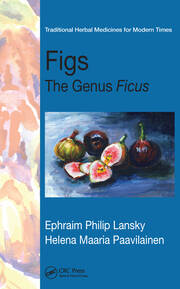
With a history as ancient as any cultivated fruit, many believe the fig has been with us even longer than the pomegranate. The Ficus constitutes one of the largest and hardiest genera of flowering plants featuring as many as 750 species. Although the extraordinary mutualism between figs and their pollinating wasps has received much attention, the phylogeny of both partners is only beginning to be reconstructed. The fig plant does have a long history of traditional use as a medicine and has been a subject of significant modern research.
Figs, the Genus Ficus brings together those histories, ancient and modern, to present an extraordinary profile of an extraordinary plant with an abundance of medical uses and a reputation as both a delicacy and a diet staple in some regions of the world. Several chapters within the book are devoted to intensive study of different parts of the tree: fruits, leaves, bark and stem, roots, and latex. These chapters discuss the Ficus genus as a whole, including the botany of the most important species that have been related to that particular part pharmacologically.
The authors, Dr. Ephraim Lansky MD, highly respected as one of the world’s only physician pharmcognocists and Dr. Helena Paavilainen, a renowned researcher of natural products, go on to consider the chemistry and pharmacology of each part in selected Ficus species, and modern, medieval, and ancient methods for obtaining and preparing the beneficial components from that plant part for medicinal use. Special attention is paid to the plants' propensity for fighting inflammation, including cancer. Figs’ future potential is considered in a number of treatments, as are future areas of research.
- Includes a wealth of comparative tables for quick reference
- Provides dozens of illustrative and original high-quality photos as well as drawings and chemical structures
- Offers complete references after every chapter
Figs, the Genus Ficus is a book in the CRC Press Series, Traditional Herbal Medicines for Modern Times, edited by Roland Hardman. Each volume in this series provides academia, health sciences, and the herbal medicines industry with in-depth coverage of the herbal remedies for infectious diseases, certain medical conditions, or the plant medicines of a particular country.
Figs, the Ficus trees, are an understudied genus in modern pharmacognosy. This book present a multidisciplinary approach to the botany, chemistry, and pharmacology of fig trees and figs of the Ficus species, including the fig of commerce, Ficus carica, the rubber tree, Ficus elastic, and the Bo tree, Ficus religiosa. Traditional and current uses of figs in medicine are discussed in detail. The book also explores how figs and fig tree parts are processed, and the pharmacological basis underlying the potential efficacy of preparations is investigated in relation to their chemical composition. The book moves seamlessly from mythology to botany to ethnomedicine to pharmacology to phytochemistry.
Read less