





272 Pages
21 B/W Illustrations
by
Routledge
272 Pages
by
Routledge
240 Pages
by
Routledge
Also available as eBook on:
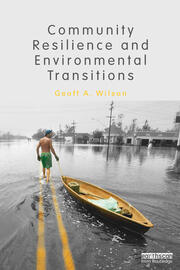
This book discusses the resilience of communities in both developed and developing world contexts. It investigates the notion of ‘resilience’ and the challenges faced by local communities around the world to deal with disturbances (natural hazards or human-made) that may threaten their long-term survival. Using global examples, specific emphasis is placed on how learning processes, traditions,... Read more
1. Introduction 2. Towards a Framework for Understanding Community Resilience 3. Transition Theory: Environmental Pathways and Resilient Communities 4. System Memory: Community Learning, Tradition and Historical Networks 5. Path Dependency: 'Lock-In' Mechanisms and Pathways of the '(Im)possible' 6. Transitional Corridors: External Constraints for Endogenous Community Resilience 7. Environmental transitions and the Policy Challenge: How to make Local Communities More Resilient 8. Conclusions
Biography
Geoff Wilson has worked on research topics linked to human-environment interactions for the past 20 years, with extensive research conducted in various geographical settings including New Zealand, Australia, Germany, Switzerland and the UK. He has published several books, including 'Environmental Management: New Directions for the 21st Century' and is currently Editor of the journal 'Geography Compass: Environment and Society'.
'Community Resilience and Environmental Transitions is a welcome addition to studies of the increasingly pervasive concept of resilience.' – Gerald Taylor Aiken, Environmental Values
