





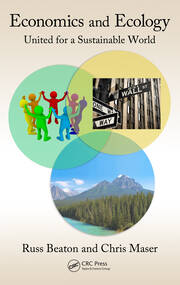
1st Edition
Economics and Ecology United for a Sustainable World
Introduction
SETTING THE STAGE
Methodological Overview
Symptomatic Analysis
Systemic Analysis
An Evolutionary View of America
Lessons from Our Energy History
Energy—The Critical Resource
The Flow of Energy Is the Only Real Economy
Follow the Energy—Not the Money
Lessons from the Laws of Thermodynamics
Five Operating Principles
ECONOMICS IN THEORY AND PRACTICE
The Innate Nature of Economics
Scarcity and Human Survival
Economics and Human Nature
Rational Economic Man
From Necessities to Wants and Subsistence to Wealth
Misuse of Economics in Practice
Growth as Economic Religion
Consumption Theory
Consumption for Survival
Consumption in Practice
Affluence as an Unmitigated Public Good
Toward an Economics of Enough
Production
Original Intention: Meet Human Necessities
The Goal Has Been Unlimited Production
Reconciling the Differences
The Concept of Productivity
Externalities
Politics, Economics, and Externalities
Understanding the Language
The Nature of Markets
Imperfect Property Rights
Proceeding through Example—The Paper Mill
Drawing Some Conclusions
Facing Uncertainty
Distribution
The Question of Who Gets What
Distribution: The All-Important, Ignored Element
Economic Methodology Thwarts Redistribution
Revisiting the Notion of Surplus
Inequality and Economic Realities
Equity and Social Justice—The Key to Real Sustainability
Macroeconomics—Is It Still Helpful in an Age of Scarcity?
Origins of Macroeconomics
Basic Macroeconomic Worldview
The Keynesian Dilemma—Unemployment or Inflation?
Controlling the Economy
Revisiting the Capitalist Scenario
Age of Scarcity Changes the Paradigm
A Growing Economy, a Planet in Peril
RECONCILIATION AND LOOKING TO THE FUTURE
The Meaning of Social-Environmental Sustainability
The Three Pillars of Sustainability
Understanding the Triple Bottom-Line
Sustainability in Practice—The Track Record
Imagining the Ideal World
We Can Only Move toward a Positive
Economic Development in the Current World
Targeting the Strategy
Counsel for Getting There
Resource Overexploitation
Communities Must Actively Plan Their Own Futures
Broad-Based Participation a Necessity
Need for Bottom-Up Thinking
A Final Word on Growth
Summing Up
Appendix
Index
Chapters include endnotes.
Biography
Russ Beaton received his bachelor’s degree from Willamette University in Salem, Oregon, and his Master’s and Ph.D. degrees from Claremont University, California. His original training was in mathematical economics and econometrics, although his doctoral thesis was in location theory and urban land economics, which became a lifetime interest.
After teaching for 3 years at California State College at Fullerton (now Fullerton State University), and 4 years at Simon Fraser University in Vancouver, British Columbia, Canada, Beaton returned to his alma mater, Willamette University, where he taught economics and did research for 33 years.
He has consulted and done policy-based contract research for at least six different agencies of the State of Oregon, in areas such as land use, agriculture, timber, transportation, energy, housing, and general economic policy.
Beaton is coauthor with Chris Maser of two other books and participated in drafting the legislation, passed by the 1973 Oregon Legislature, that created Oregon’s widely acclaimed land use planning system.
Chris Maser was trained in zoology and ecology and worked for 25 years as a research scientist in agricultural, coastal, desert, forest, valley grassland, shrub steppe, and subarctic settings in various parts of the world before realizing that science is not designed to answer the vast majority of questions society is asking it to address.
Maser gave up active scientific research in 1987 and has since worked to unify scientific knowledge with social values in helping to create sustainable communities and landscapes, part of which entails his facilitating the resolution of social-environmental conflicts. He has contributed to more than 286 publications, including 34 books, mostly dealing with some aspect of social-environmental sustainability.
Although he has worked and lectured in Canada, Egypt, France, Germany, Japan, Malaysia, Mexico, Nepal, Slovakia, and Switzerland, he calls Corvallis, Oregon, home.
