




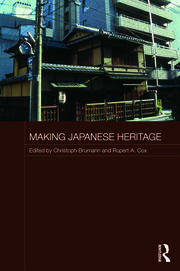
Preface - Joy Hendry Introduction - Rupert Cox and Christoph Brumann Part I: Performing Japaneseness through Heritage 1: Making ‘Japanese’ Tea - Kirsten Surak 2: Before Making Heritage: Internationalisation of Geisha in the Meiji Period - Mariko Okada 3: Making Art in the Japanese Way: Nihonga as Process and Symbolic Action - Arunas Gelunas Part II: Institutionalising Japanese Heritage 4: Architecture, Folklore Studies, and Cultural Democracy: Nagakura Saburô and Hida Minzoku-mura - Peter Siegenthaler 5: Nô Masks on Stage and in Museums: Approaches to the Contextualisation and Conservation of the Pitt Rivers Museum Nô Mask Collection - Rachel Payne 6: Company Culture or Patinated Past? The Display of Corporate Heritage in Sumitomo - Bart Gaens Part III: Japanese Local Heritage and the Wider World 7: A Heady Heritage: The Shifting Biography of Kashira (Puppet Heads) as Cultural Heritage Objects in the Awaji Tradition - Jane Marie Law 8: The Case of the Sash: A Search for Context in Okinawa - Amanda Mayer Stinchecum 9: Houses in Motion: The Revitalization of Kyoto’s Architectural Heritage - Christoph Brumann 10: Automated Alterities: Movement and Identity in the History of the Japanese Kobi Ningyô - Rupert Cox Part IV: Perpetuating Japanese Heritage 11: Maintaining a Zen Tradition in Japan: The Concrete Problem of Priest Succession - Masaki Matsubara 12: Debating the Past to Determine the Future in Shinkyo, a Japanese Commune - Michael Shackleton
Biography
Rupert Cox: (important publications)
'Is there a Japanese Way of Playing" in Japan at Play: The ludic and logic of power eds Hendry and Ravieri (Routledge 2001)
The Zen-Arts: An Anthropological Study of the Culture of Aesthetic Form in Japan (ROutledge, 2003)
"Wagamama technology - An uncanny history of Japanese robot technology" in Japan as a model of Asian modernisation eds Raud
Japan and the Cultures of Copying: Historical and anthropological approaches (Routledge)
Christoph Brumann: (select list)
Whose Kyoto? Machizukuri, Local Autonomy and Patonashippu in an Old City. In: Carola Hein & Philippe Pelletier (ed.) Cities, Autonomy, and Decentralization. London: Routledge.
Writing for Culture: Why a Successful Concept Should Not Be Discarded. In: Robert L. Welsch & Kirk M. Endicott (eds.), Taking Sides: Clashing Views in Cultural Anthropology. (Second ed.) New York: McGraw-Hill (Reprint of 1999 Current Anthropology article).
Copying Kyoto: The Legitimacy of Imitation in Kyoto's Townscape Debates. In: Rupert Cox (ed.) Japan and the Culture of Copying. London: RoutledgeCurzon.
Stamm - Volk - Ethnizitat - Kultur: Die aktuelle Diskussion [Tribe - People - Ethnicity - Culture: The Current Debate]. In: Sabine Rieckhoff & Ulrike Sommer (eds.) Auf der Suche nach Identitaten: Volk - Stamm - Kultur - Ethnos. Internationale Tagung 8.-9.12.2000, Leipzig [In Pursuit of Identities: People- Tribe - Culture - Ethnos]. (British Archaeological Reports, International Series.) Oxford.
Writing for Culture: Why a Successful Concept Should Not Be Discarded. Pp. 43-77 in: Adam Muller (ed.), Concepts of Culture: Arts, Politics, and Society, Calgary: University of Calgary Press (Reprint of 1999 Current Anthropology article).
Kyotos Dilemma: Das Stadtbild als commons [Kyoto's Dilemma: The Townscape as Commons]. In: Werner Pascha & Cornelia Storz (eds.) Wirkung und Wandel von Institutionen: Das Beispiel Ostasien [Institutional Effects and Institutional Change: The Case of East Asia], pp. 133-168. Stuttgart: Lucius & Lucius.
Der urbane Raum als offentliches Gut: Kyoto und die Stadtbildkonflikte [Urban Space as a Public Good: Kyoto and the Townscape Conflicts]. Zeitschrift fur Ethnologie 129:183-210.
Intentional Communities in Japan. In: Karen Christensen & David Levinson (eds.) Encyclopedia of Community, vol. 2, pp. 739-743. Thousand Oaks, Ca.: Sage.
"All the Flesh Kindred That Ever I See": A Reconsideration of Family and Kinship in Utopian Communes. Comparative Studies in Society and History 45:395-421.
