





1st Edition
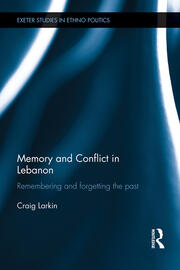
Memory and Conflict in Lebanon Remembering and Forgetting the Past
1. Introduction: Beyond the War? 2. Locating a Postmemory Generation 3. Contesting Lebanon: History, Identity and Co-existence 4. (Re)Imagining the Nation: School, Street and the ‘Independence Intifada’ 5. Space, Place and Site: Inhabiting Postwar Memoryscapes 6. Time, Story and Myth: Narrating Lebanon’s Future 7. Conclusions
Biography
Craig Larkin is a lecturer in Comparative Politics of the Middle East at Department of Middle East and Mediterranean Studies, King's College London. He was previously a research fellow at Exeter Politics department, working on an ESRC funded project 'Conflict in Cities and the Contested State' (2008-2012). He holds a PhD in Middle East Studies from the University of Exeter (Institute of Arab and Islamic Studies, 2009), an MA in Criminology and Criminal justice (LLM, 1999) and a BA(Hons) in Law and Politics (LLB, 1998) from Queen's University, Belfast.
His first monograph, Memory and Conflict in Lebanon: Remembering and Forgetting the Past was published by Routledge in January 2012. This research emerged from four years spent in the Middle East (2001-2004), studying Arabic at Damascus University while also assisting in community development projects in Lebanon, Jordan and Iraq. His second co-authored book, The Struggle for Jerusalem's Holy Places: Radicalisation and Conflict will be published by Routledge in 2013.
"His writing remains always sober, collected, impartial, and most of all decent, adding much needed substance depth and class to the literature on Lebanon’s history and memory."- Franck Salameh, The Levantine Review, 2012.
