





1st Edition
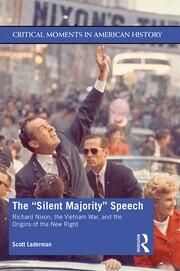
The "Silent Majority" Speech Richard Nixon, the Vietnam War, and the Origins of the New Right
Series Introduction
List of Figures
Acknowledgments
A Brief Note on Language
Timeline
Part One:
Introduction. Toward "Peace"
1. Richard Nixon, the Cold War, and Southeast Asia
2. Vietnamization and the Illusion of Peace
3. Nixon and the Bloodbath Theory
4. The "Great Silent Majority" and Right-Wing Revanchism
Epilogue. Conjuring Nixon in the Twenty-First Century
Part Two: Documents
1. Richard Nixon, "Address to the Nation on the War in Vietnam," November 3, 1969
2. Mrs. Dennis W. Harrison to Richard Nixon, November 4, 1969
3. Commentary by George Salem, KWGN Television, November 5, 1969
4. Editors, "President on Solid Ground in Search for Vietnam Peace," Orlando
Sentinel, November 5, 1969
5. Robert T. Park, et al., to Richard M. Nixon, November 17, 1969
6. Excerpt from Colonel Robert D. Heinl, Jr., "The Collapse of the Armed
Forces," Armed Forces Journal (June 7, 1971)
7. Excerpt from George McT. Kahin, "History and the Bloodbath Theory in Vietnam," New
York Times, December 6, 1969
8. Richard Nixon, "Address to the Nation on the Situation in Southeast
Asia," April 30, 1970
Index
Biography
Scott Laderman is a professor of history at the University of Minnesota, Duluth. His previous books include Tours of Vietnam: War, Travel Guides, and Memory (2009) and Empire in Waves: A Political History of Surfing (2014).
"In his concise analysis of President Richard Nixon’s 'Silent Majority' speech, Scott Laderman elucidates how Nixon used his policy of 'positive polarization' to pursue his effort toward victory in Vietnam, and demonstrates how President Nixon’s speech helped bring forth the rise of the political right. An excellent examination of the beginnings of the political discourse that have shaped post-Vietnam War America."
David F. Schmitz, Robert Allen Skotheim Chair of History, Whitman College, USA
