




1st Edition
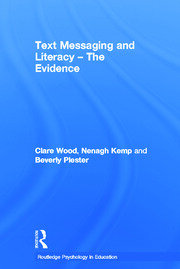
Text Messaging and Literacy - The Evidence
Biography
Clare Wood is Professor of Psychology in Education at Coventry University, UK. She is Editor-in-Chief of the Journal of Research in Reading and is the Director of the Centre for Applied Research in Psychology. Nenagh Kemp is Senior Lecturer in the School of Psychology, University of Tasmania (UTAS), Australia, and is also Associate Editor for the Journal of Research in Reading. Beverly Plester is an Honorary Research Fellow in the Department of Psychology and Behavioural Sciences, Coventry University, UK.
"I was impressed by the way the authors evaluated and discussed research methods throughout, but in particular they devote a chapter to methodological issues. This chapter reviews the strengths and weaknesses of the different techniques used to elicit, collect and interpret textisms. The authors cover self-report, observational and experimental methods and ways to analyse include counting, categorising and thematic analysis. The chapter will be of great use to researchers wanting to interpret work already conducted and to help them plan future studies in a way that allows them to draw the most meaningful interpretations from their data." - Jacqui Taylor, Bournemouth University, UK
