




1st Edition
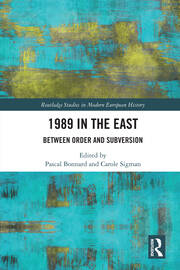
1989 in the East Between Order and Subversion
Introduction
Pascal Bonnard and Carole Sigman
1 The multiple posthumous lives of Imre Nagy, the Hungarian hero of 1989
Catherine Gousseff
2 The ecological discourse of the Round Table as part of the neoliberal turn in Poland
Iwona Bojadżijewa
3 The "happening of the people" in Yugoslavia at the end of the 1980s: Mass movements and disrupted meanings in a disintegrating society
Anne Madelain
4 The role of the working class in the collapse of bureaucratic socialism in Albania (1990–1991)
Arlind Qori
5 A paradoxical triumph: The rise and fall of Soviet academic environmentalism (1973–1991)
Laurent Coumel
6 Household plots and the second economy: Continuities and transformations from late Soviet Russia to the transition period
Svetlana Barsukova and Caroline Dufy
7 The transnational action of Baltic independence movements in the USSR (1988–1991)
Katerina Kesa
Biography
Pascal Bonnard is a political scientist and associate professor at Jean Monnet University of Saint-Etienne (France). He has worked on the politicisation of ethnicity and of memory in the post-Soviet space and on the circulation of norms at the margins of Europe. His current research topics include the workers from the Eastern Bloc (teachers, engineers, doctors) in the Arab countries during the Cold War and the reorganisation of the French administration in Algeria after the country’s independence.
Carole Sigman is a senior research fellow at the French National Centre of Scientific Research (CNRS) and a member of the Centre for Russian, Caucasian, Eastern European and Central Asian Studies (CERCEC, CNRS/EHESS). As a political scientist, she focuses on the authoritarian systems and their transformations. She first studied the disintegration of the Soviet system through the history of the Moscow "informal" political clubs during perestroika and is now exploring the contemporary Russian authoritarian regime by focusing on the transformations and reforms of the university system.
