





1st Edition
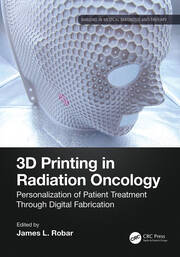
3D Printing in Radiation Oncology Personalization of Patient Treatment Through Digital Fabrication
Chapter 1 Introduction and Clinical Perspective
Chapter 2 A brief introduction to 3D printing
Chapter 3 Biocompatibility and sterilization of 3D printed radiation therapy devices
Chapter 4 3D printing for external beam photon therapy
Chapter 5 3D printing for electron therapy
Chapter 6 3D printing for proton therapy
Chapter 7 Applications on brachytherapy
Chapter 8 3D printed patient immobilization
Chapter 9 3D printed radiation detectors
Chapter 10 3D printed phantoms in RT
Chapter 11 Operationalizing 3D printing in the radiation oncology department
Index
Biography
James L. Robar, PhD, FCCPM is a globally recognized medical physicist, the Chief of Medical Physics at Nova Scotia Health, a professor of radiation oncology at Dalhousie University and a specialist in the high technology of radiotherapy— a treatment technique used for roughly half of all patients with cancer. He is also co-founder and CSO at Adaptiiv Medical Technologies, a medical-tech firm in Halifax, with the mission of improving the accuracy of cancer treatment. As a scientist, inventor, and entrepreneur, Dr. Robar has pioneered multiple advancements improving imaging and treatment delivery for radiotherapy. These technologies include enhanced imaging to improve the accuracy of targeting tumors with radiation, hardware and software detecting submillimeter motion of patients to improve the precision of treatment, planning algorithms to provide improved sparing of healthy tissues and organs, and turnkey solutions allowing intelligent design of 3D printed, patient-specific accessories used during radiotherapy. For his contributions in this field, he became a Canadian Governor General’s Innovation Laureate in 2021.
