




1st Edition
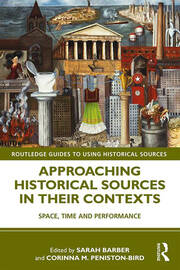
Approaching Historical Sources in their Contexts Space, Time and Performance
List of Figures
List of Contributors
Acknowledgements
Introduction
Sarah Barber and Corinna M. Peniston-Bird
1 Building: Constructing Identities
Sarah Barber
2 Landscape: Consuming Natural Places
Mark C. J. Stoddart and Christine Knott
3 Cemeteries: Tracing Sepulchral Cultures
Felix R. Schulz
4 Memorials: Associative Meanings
Corinna M. Peniston-Bird
5 Masque and Opera: Staging Performance
Andrew Pinnock
6 Radio: Listening to the Airwaves
Tony Stoller
7 Television: Capturing Performance
Philip Kiszely
8 Digital Surrogates: Archaeological Materialities
Adam Rabinowitz
9 Objects: Dynamics of Display
Sarah Ann Robin
10 Clothing: Reading what was Worn
Laura R. Prieto
11 Photo Albums: Autobiographical Narrations
Cord Pagenstecher
12 Scrapbooks: Proliferations of Meaning
Eloise Moss
Index
Biography
Sarah Barber is Senior Lecturer in History at Lancaster University, UK. She publishes widely on early modern Britain, Ireland and the colonial Americas. Her recent work reconfigures colonialism, decolonising the writing of colonial encounter, such as in the monograph, The Disputatious Caribbean (2014). Recovering the voices of the silent and silenced spurs her work to expand historical source material.
Corinna M. Peniston-Bird is Senior Lecturer in Gender and Cultural History at Lancaster University, UK. She works on experiences and cultural memories of war, focussing largely on the World Wars. Her interests lie in the disruptive, the excluded and the marginalized and the sources which allow historians that focus. Her recent publications have explored British memorials, wartime cinema and the significance of wartime memories of bananas.
'Scholars of all spatial and temporal contexts will welcome this collection which is fizzing with ideas on how to interpret the past whilst attending to the vagaries of space, time and the relationship between the two. The authors gathered here grapple with the complexities of context for the analysis of evidence which often appears fixed in time and space and present myriad ways of interpreting sources which are mutable when understood as co-created, shared and responsive to context. This is an important collection for anyone engaging with the spatial, material and temporal turns and who wishes to strike out from the linear narrative to think about how we make sense of our sources – from buildings to photograph albums, clothing to media performance – as they respond to and gather responses from consumers, audiences, viewers and listeners. Barber and Peniston-Bird have produced a challenging collection which stretches our imagination to consider the traces of the past in new and complex ways.'
Professor Lynn Abrams, University of Glasgow, UK
