




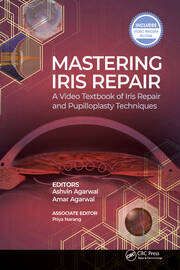
1st Edition
Mastering Iris Repair A Video Textbook of Iris Repair and Pupilloplasty Techniques
Dedication Website Contents Acknowledgment
About the EditorsContributing Authors Preface
Foreword by William B. Trattler, MD
Section I Iris Repair Techniques
Chapter 1 Introduction, Indications, and Salient Points of Iris Tissue and Repair Case Presentation. Cigarette Lighter Injury
Chapter 2 Mastering the McCannel Suture and Modified McCannel Suture Techniques Case Presentation. Modified McAhmed Suture Technique
Chapter 3 Mastering the Siepser Iris Suture Technique Case Presentation. Cionni Technique for Iris Coloboma Repair
Chapter 4 The Iris Cerclage Suture Case Presentation. Subluxated Intraocular Lens in a Large Eye With Iris Cerclage
Chapter 5 Mastering the Single-Pass Four-Throw Pupilloplasty Case Presentation 1. Single-Pass Four-Throw Pupilloplasty Case Presentation 2. Yamane Technique With Single-Pass Four-Throw Pupilloplasty
Chapter 6 Iridodialysis Repair Management Case Presentation 1. Sewing Machine Technique for Iridodialysis Repair Case Presentation 2. Modified Sewing Machine Technique for Iridodialysis Repair, Intraocular Lens Relocation, Iris Coloboma Repair, Cionni Ring Fixation, and Scleral Fixated Intraocular Lens
Section II Iris Repair and Pupilloplasty Special Topics
Chapter 7 Pupilloplasty in Special Indications: Urrets-Zavalia Syndrome and Secondary Glaucoma Case Presentation 1. Urrets-Zavalia Syndrome Post Penetrating Keratoplasty Case Presentation 2. Surgical Pupilloplasty in Angle-Closure Glaucoma
Chapter 8 Pupilloplasty in Com
Partmentalizing the Eye: Endothelial Keratoplasty Including Pre-Descemet's Endothelial Keratoplasty With Glued Intraocular Lens/Yamane Technique Case Presentation 1. Triple Procedure of Pre-Descemet's Endothelial Keratoplasty With Glued Intraocular Lens and Single-Pass Four-Throw Pupilloplasty Case Presentation 2. Yamane Technique. Flanged Intrascleral Intraocular Lens Fixation With Double-Needle Technique
Chapter 9 Iris Prosthesis Devices Case Presentation 1. Aniridia Rings Case Presentation 2. Sutured Artificial Iris Case Presentation 3. Artificial Iris With Yamane Technique. Double-Needle Scleral Intraocular Lens and Artificial Iris Fixation
Chapter 10 Twofold Technique for Iridodialysis Repair Case Presentation 1. Twofold Technique for Iridodialysis Repair Case Presentation 2. Iridodialysis Handled With Riveting Technique With Double-Flanged Polypropylene Suture
Chapter 11 Complications of Iris Repair and Pupilloplasty Techniques Case Presentation. Iatrogenic Iridodialysis Complication and Management
Section III Extended Implications of Iris and Pupil Repair
Chapter 12 Aniridia Case Presentation. Iatrogenic Aniridia
Chapter 13 Pinhole Pupilloplasty Case Presentation. Pinhole Pupilloplasty in Keratoconus
Chapter 14 Tools for Repair of the Iris Case Presentation. Vitrector Used to Create a Pinhole Pupil for Refractive Surprise
Chapter 15 Pinhole Intraocular Lens: All You Need to Know Case Presentation. XtraFocus Intraocular Lens in a Postoperative Radial Keratotomy Eye
Chapter 16 Iris Tumors and Cysts Case Presentation. Iris Pigment Epithelial Cyst Removal and Defect Repair Financial Disclosures
Index
Biography
Ashvin Agarwal, MBBS, MS is Chief of Clinical Services and Director of Dr. Agarwal’s Group of Eye Hospitals and Eye Research Centre, which has more than 97 hospitals worldwide, and a subcommittee member of the International Society of Refractive Surgery. He is a cataract, cornea, and refractive surgeon with a special interest in handling complex and complicated cases, such as nucleus drop, IOL drop, trauma, iris and anterior segment reconstruction, and corneal decompensation. Dr. Agarwal was instrumental in performing a new form of surgery called vitrectomy-assisted phacoemulsification for aqueous misdirection syndrome. He also started the extrusion cannula-assisted levitation technique for dropped IOL.
Amar Agarwal, MS, FRCS, FRCOphth is the Chairman and Managing Director of Dr. Agarwal’s Group of Eye Hospitals and Eye Research Centre in India, which includes 97 hospitals worldwide; past President of the International Society of Refractive Surgery; and Secretary General of the Indian Intraocular Implant & Refractive Society.
Dr. Agarwal is the pioneer of phakonit, which is phacoemulsification with needle incision technology. This technique became popularly known as bimanual phaco, microincision cataract surgery, or microphaco. Dr. Agarwal was the first to remove cataracts through a 0.7-mm tip with the microphakonit technique. He also discovered no anesthesia cataract surgery and FAVIT (fallen vitreous), a new technique to remove dropped nuclei. Using an aquarium fish pump to increase the fluid into the eye in bimanual phaco and coaxial phaco has helped prevent surge. This formed the basis of various techniques of forced infusion for small-incision cataract surgery. Dr. Agarwal also discovered a new refractive error called aberropia. He was the first to perform a combined surgery of microphakonit (700-μm cataract surgery) with a 25-gauge vitrectomy in the same patient, thus creating the smallest incisions possible for cataract and vitrectomy. He was the first surgeon to implant a new mirror telescopic intraocular lens (IOL) for patients suffering from age-related macular degeneration. He was the first in the world to implant a glued IOL, in which a posterior chamber IOL is fixed in an eye without capsules using fibrin glue. He modified the Malyugin ring (MicroSurgical Technology) for small-pupil cataract surgery into the Agarwal modification of the Malyugin ring for miotic pupil cataract surgeries with posterior capsular defects.
Dr. Agarwal pioneered the technique of IOL scaffold, in which a 3-piece IOL is injected into an eye between the iris and the nucleus to prevent the nucleus from falling in posterior chamber ruptures. He combined glued IOL and IOL scaffold in cases of posterior chamber rupture where there is no iris or capsular support and termed the technique glued IOL scaffold. Pre-Descemet’s endothelial keratoplasty was also pioneered by Dr. Agarwal. In this procedure, the pre-Descemet’s layer and Descemet’s membrane with endothelium are transplanted en bloc in patients with a diseased endothelium.
The first contact lens–assisted collagen cross-linking procedure, a new technique for cross-linking thin corneas, was performed in Dr. Agarwal’s Eye Hospital, as were the first anterior segment transplantation in a 4-month-old patient with anterior staphyloma and the first glued endocapsular ring in cases of subluxated cataracts. Endoilluminator-assisted Descemet’s membrane endothelial keratoplasty is also performed in Dr. Agarwal’s Eye Hospital.
Dr. Agarwal has designed a new instrument for complicated cases called the trocar anterior chamber maintainer, which helps provide infusion through the anterior chamber and works like a trocar cannula. He has also started a new technique of iris suturing called single-pass four-throw pupilloplasty. This is used for closed-angle glaucoma, silicone oil-induced closed-angle glaucoma, and mydriatic cases. He has performed for the first time pinhole pupilloplasty to treat patients with astigmatism of up to 20 diopters.
Dr. Agarwal has performed more than 150 live surgeries at various conferences. His videos have won awards at the film festivals of the American Society of Cataract and Refractive Surgery, American Academy of Ophthalmology, and European Society of Cataract & Refractive Surgeons. He has written more than 75 books, which have been published in various languages, including English, Spanish, and Polish. He trains doctors from all over the world in his center on phaco, glued IOL, LASIK, and retinal surgeries.
The website of Dr. Agarwal’s Eye Hospitals is www.dragarwal.com
Priya Narang, MS is Director of the Narang Eye Care & Laser Centre. In 1998, she earned her master of surgery in ophthalmology from B.J. Medical College in India.
Dr. Narang is a pioneer of the no-assistant technique for glued IOL. Her technique was published in the Journal of Cataract & Refractive Surgery in 2013 and was among the most-read top-5 articles for 2 quarters. She is also a pioneer of the widely accepted single-pass four-throw pupilloplasty technique that has various applications in the field of ophthalmology.
Dr. Narang has contributed many chapters and is an editor to various books published by top international publishers, including her latest book, Optimizing Suboptimal Outcomes Following Cataract Surgery. She is a reviewer to peer-reviewed journals, such as the Indian Journal of Ophthalmology. In 2016, she served as a consultant for the Focal Point Module at the American Academy of Ophthalmology. Her video blog on Ocular Surgery News features complex and challenging cataract cases.
In 2013, her paper “Glue-Assisted Intrascleral Fixation of Posterior Chamber Intraocular Lens” won the Indian Journal of Ophthalmology’s gold award for best paper. That same year, the Intraocular Implant & Refractive Society in India awarded her a gold medal for her contributions to the field of ophthalmology. For the past 3 years, her videos have been chosen for the Global Video Contest by the American Academy of Ophthalmology.
She is an internationally renowned speaker who regularly presents at the American Society of Cataract and Refractive Surgery, American Academy of Ophthalmology, World Ophthalmology Congress, and All India Ophthalmological Society.
