





1st Edition
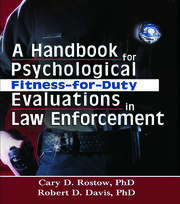
A Handbook for Psychological Fitness-for-Duty Evaluations in Law Enforcement
336 Pages
by
Routledge
314 Pages
by
Routledge
314 Pages
by
Routledge
Also available as eBook on:
While some books about police psychology contain a chapter on the fitness-for-duty question, this is the first comprehensive publication focused exclusively on psychological fitness-for-duty evaluations (FFDEs) for law enforcement personnel. This handbook is ideal for professionals and for coursework designed to prepare individuals for careers as police or municipal officials, psychologists,... Read more
- Preface and Acknowledgments
- SECTION I: THE HISTORY AND DEVELOPMENT OF POLICE PSYCHOLOGY
- Chapter 1. Law Enforcement Agencies and Police Psychology
- American Policing
- The First American Police Reform Movement
- The Second American Police Reform Movement
- The Third American Police Reform Movement
- U.S. Police Structures
- Early Police Psychological Testing
- Development of Professional Police Psychology and EAPs
- Some Contemporary Issues in Policing
- Chapter 2. Police Culture and Assessment/Therapy Issues
- Culture
- Police-Specific Psychological Assessment, Treatment, and EAP
- Special Issues of Psychotherapy in Police Settings
- Mental Health Programs
- Chapter 3. Law Enforcement Liability and Police Psychology
- The Civil Rights Act of 1871
- Municipal Liability
- Case Law
- Failure to Discipline
- Expert Testimony by the FFDE Provider
- Duty to Warn
- Liability for the Certifying Provider
- The Right to Offer Opinion of Mental Health Before Employment
- SECTION II: THE MECHANICS OF THE FITNESS-FOR-DUTY EVALUATION METHODOLOGY
- Chapter 4. Usefulness of Fitness-for-Duty Evaluations in Law Enforcement Agencies
- The Case of Officer Bob
- The Law Enforcement Executives’ Choices
- The FFDE Option
- Chapter 5. Defining the Fitness-for-Duty Evaluation
- Who May Offer the FFDE Service?
- Positive Risk
- Negative Risk
- Chapter 6. Developing a Fitness-for-Duty Evaluation System
- Friend of the Chief
- General FFDE Goals
- Administrative Conflict of Interest
- Chapter 7. Forms and Styles for the Fitness-for-Duty Evaluation in Law Enforcement
- Officer Instructions
- Officer Personal Information
- Directions for an FFDE Appearance
- Third-Party Observations
- Electronic Recordings
- Copy of the Report
- Defamation
- Misrepresentation on FFDEs
- Résumé Fraud and Free Speech
- FFDE Confidentiality in Court Actions
- Administrative Forms of FFDEs: Internal and External Providers
- Are FFDEs Mandatory?
- Lybarger Admonishment
- Insubordination
- Chapter 8. Assessment: Methods and Procedures
- Processing the Officer into the FFDE Setting
- Explaining the Nature of All Self-Report Materials
- Ending the FFDE Contact with the Officer
- Immediate LE Executive Feedback
- The Minimum Necessary Rule
- Independent Treatment Review Service
- Psychology and Law Enforcement Personnel Methods
- Cognitive Testing and FFDEs
- Introduction to Statistical Considerations for Police Executives
- Predictive Validity
- Clinical, Forensic, and Fitness-for-Duty Evaluations
- Chapter 9. Fitness-for-Duty Report Recommendations
- Special Records Section
- Postevaluation Outcome Assessment and Distortion
- Postassessment Treatment Recommendations
- FFDE Provider Recommendations
- Release of Records to Third Parties
- SECTION III: FORENSIC ISSUES IN FITNESS-FOR-DUTY EVALUATIONS
- Chapter 10. Expert Witnesses and the Defense of Selection/Fitness Decisions
- The Case of Detective Reed
- Federal Rules of Evidence 702
- Examining the Expert’s Methods
- Chapter 11. Reasons for Fitness-for-Duty Evaluations
- The Key Issues
- Reasons for Referral
- Chapter 12. Misuse of Fitness-for-Duty Evaluations
- The Case of Officer Tim
- Improper FFDE Referrals
- SECTION IV: FEDERAL LAW AND FITNESS-FOR-DUTY EVALUATIONS
- Chapter 13. Confidentiality of Psychological Information and t
Biography
Cary D. Rostow, Robert D. Davis
