





1st Edition
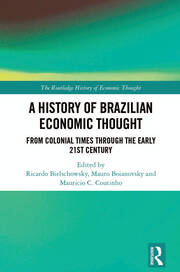
A History of Brazilian Economic Thought From Colonial Times Through The Early 21st Century
1. Editorial Introduction
Part 1: Contributions to economic theory
2. Contributions to economics from the "periphery" in historical perspective: the case of Brazil after mid-20th century
Mauro Boianovsky.
Part 2: Colonial and early post-colonial periods
3. Sugar, Slaves and Gold: the Political Economy of the Portuguese Colonial Empire in the 17th and 18th Centuries
José Luís Cardoso
4. "The transition to post-colonial economy"
Mauricio C. Coutinho
Part 3: The "coffee era"
5. Economic ideas about slavery and free labor in the 19th century
Amaury Patrick Gremaud and Renato Leite Marcondes
6. Debating Money in Brazil, 1850s to 1930
André A. Villela
7. Industrial development and government protection: issues and controversies, circa 1840–1930
Flávio Rabelo Versiani
Part 4: The "developmentalist" and the "globalization" eras
8. Brazilian economic thought in the "developmentalist era": 1930-1980
Ricardo Bielschowsky and Carlos Mussi
9. The end of developmentalism, the globalization era
and the concern with income distribution (1981-2010)
Eduardo F. Bastian and Carlos Pinkusfeld Bastos
Biography
Ricardo Bielschowsky is full professor of economics at Universidade Federal do Rio de Janeiro, Brazil.
Mauro Boianovsky is full professor of economics at Universidade de Brasília, Brazil.
Mauricio C. Coutinho is full professor of economics at Universidade de Campinas, Brazil.
"This is a more than welcome initiative, filling a long-standing gap in the English language on the evolution of economic ideas in the largest and most populous country of South America."
Rogério Arthmar, History of Economic Ideas
