




2nd Edition
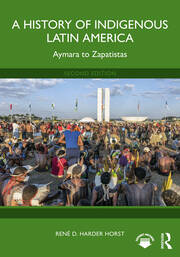
A History of Indigenous Latin America Aymara to Zapatistas
List of Figures List of Maps List of Textboxes Acknowledgments Introduction: Indigenous People from South America meet an Important Person 1. Indigenous Latin America: Introductions, Methodology, and Definitions 2. Indigenous Latin America: Abya Yala 3. Indigenous Encounters with Europeans: The Fifteenth Century 4. Natives Challenge the Conquerors Yet Help Create a New World, 1500 to 1549 5. Colonial Alliances and Demographic Collapse, 1550 to 1599 6. The High Colonial Period Indigenous People Join Imperial Systems, 1600 to 1649 7. Transculturation, Urbanization, and Isolated Revolts, 1650 to 1699 8. Demographic Recovery and Growing Insurrections, 1700 to 1749 9. Religious Conflicts, Widespread Resistance, and Nation States, 1750 to 1825 10. Indigenous Responses to New Rulers and Frontier Expansion, 1811 to 1871 11. Struggles for Land, Labor, and Political Leverage in Neocolonial Latin America, 1870 to 1929 12. Diverse Indigenous Paths toward Self-Determination, 1930 to 1971 13. Indigenous Organization and Opposition to Military Rule, 1971 to 1989 14. Indigenous People Enter the New Millennium, 1990 to 2010 15. Indigenous People Challenge Conservative Rule as the Environment Changes Conclusion: Moving Ahead with Indigenous History in Mind Glossary Bibliography Appendix 1: Organization Abbreviations Appendix 2: Indigenous People Index
Biography
Dr. René D. Harder Horst was born on the Navajo Reservation and grew up among the Qom, Mocoví and Wichi in Northern Argentina. He received a Ph.D. in history at Indiana University, and writes about the Native peoples in Paraguay and throughout the continent. Harder Horst is also author of The Stroessner Regime and Indigenous Resistance in Paraguay, El Régimen de Stroessner y la Resistencia Indígena, Military Struggle and Identity Formation in Latin America, A History of Indigenous Latin America Aymara to Zapatistas Ed. 1, as well as journal articles and book chapters about Indigenous history.
Praise for the second edition
‘This is a solid history from an indigenous perspective. The spotlight sections provide an intimate window into the actions of historical indigenous actors who shaped the perpetual struggle for human rights. The inclusion of primary documents allows readers to comprehend indigenous peoples’ motivations for writing them. The new edition offers excellent coverage of better-known countries such as Mexico and Peru, and Indigenous histories of Chile and Panama, often overlooked by scholars. Overall, it’s a well-balanced history that amplifies the voices of indigenous people and places them at the center of one of the most important regions of the world.’
Professor James V. Mestaz, Department of History, Sonoma State University"An Indigenous History of Latin America provides an excellent foundation for any Latin America history course. Horst’s focus is on the Indigenous counter-narrative, which has been long neglected, but includes such thorough historical context and diverse perspectives that nearly all Latin American historical actors feel covered. Groups like the Miskitu and Garifuna make appearances, among many others, which align with how modern readers should challenge or reconsider traditional perceptions of Indigenous identity. The second edition includes new material, such as a final chapter on modern Indigenous struggles with government and the environment. Additionally, the nuance with which he approaches modern issues such as shifting “tide” political movements frames a people just as diverse and complicated as they were during the Spanish Conquest. For instructors who wish for a thorough analysis of Indigenous cultures, Latin America history told from a compelling perspective, and consistent relevancy to the modern day, there is no work better suited."
Matthew Harris, West Virginia University,
Praise for the first edition
'Finally, a Latin America textbook that places the lives and experiences of Indigenous peoples at its center! Horst carefully introduces theoretical and conceptual debates in accessible ways as he ably covers 500 years of history from an indigenous perspective. The book’s generous sweep encompasses the diversity as well as common themes of indigenous livelihoods with close attention to native sources and voices. Centering indigenous history creates a compelling narrative thread for a coherent history that is nonetheless attentive to geographical variation and to individual experience. Unflinchingly presents indigenous peoples as both victims and protagonists. Readable, accessible, and rich in detail and analysis.'
Professor Avi Chomsky, Department of History, Salem State University, USA
'A History of Indigenous Latin America is a masterful text that provides a critical tool for teaching the history of indigenous peoples across Latin America. Impressive in its chronological and regional scope, and written with verve and flair, this book will significantly enhance the learning of undergraduate and graduate students.'
Professor Nicola Foote, Arizona State University, USA
'The native "voice" has long been under-emphasized in historical accounts of the New World, almost to the point of non-existence. René Harder Horst, in this fine and highly detailed work, thus offers a needed corrective. He demonstrates that the quality of the indigenous experience provides its own quite distinct legitimacy and proves, I think, that the Apristas of Peru are right in eschewing the traditional term "Latin America" in favor of the far more comprehensive "Indoamerica." We might very well learn from them as we go forward.'
Professor Emeritus Thomas L. Whigham, Department of History, University of Georgia, USA
'We have long needed an Indigenous history of Latin America. René Harder Horst is one of those rare and outstanding scholars who possesses the breadth and depth of knowledge necessary to tackle such an important but difficult subject. A History of Indigenous Latin America fills an important gap in the field. This engaging text will introduce students to new ways of understanding and interpreting the Americas that for far too long have been approached from a colonialist point of view. An Indigenous perspective provides a counter narrative that embraces those who are traditionally marginalized and are often left out of history. As such, this book contributes a much more complete understanding of the Americas than that to which we have previously had access.'
Professor Marc Becker, Department of History, Truman State University, USA
'A History of Indigenous Latin America . . . contains a complete historical-anthropological [picture], from pre-Columbian times to modernity . . . [and] allows us to understand . . . the complexity of this continent.'
Professor Henryk Gaska, Department of Anthropology, Catholic University of Asunción and the National University of Itapua, Paraguay
'This book represents a unique effort for uniting this diverse and sometimes contradictory corpus and, at the same time, methodologically overcoming the boundaries found when trying to tackle these plural histories . . . In times when indigenous peoples in Latin America are leading social, political and environmental processes that are greatly influencing the region, this study will broaden . . . the depth and relevance of their current role and encourage research on a common cultural heritage.'
Professor Mireya Salgado Gómez, FLACSO, Ecuador
