




1st Edition
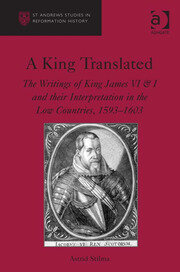
A King Translated The Writings of King James VI & I and their Interpretation in the Low Countries, 1593–1603
By Astrid Stilma
Copyright 2012
344 Pages
by
Routledge
344 Pages
by
Routledge
344 Pages
by
Routledge
Also available as eBook on:
King James is well known as the most prolific writer of all the Stuart monarchs, publishing works on numerous topics and issues. These works were widely read, not only in Scotland and England but also on the Continent, where they appeared in several translations. In this book, Dr Stilma looks both at the domestic and international context to James's writings, using as a case study a set of Dutch... Read more
Introduction; Chapter 1 Publishers and Translators; Chapter 2 Translation; Chapter 3 The Battle of Lepanto; Chapter 4 Basilikon Doron; Chapter 5 Meditations; Chapter 6 Daemonologie; conclusion Conclusion;
Biography
strid Stilma Canterbury Christ Church University, UK
'... this is a very valuable addition to the growing scholarship on the practice of early modern translation and the representation of royal authority.' English Historical Review 'Astrid Stilma analyzes key distinctions between the king's major writings and their Dutch translations in A King Translated. ... It is a study ultimately useful to any scholar interested in Reformation politics or the early modern book industry.' Sixteenth Century Journal 'Stilma carefully unpicks all such professional, intellectual, and ideological networks, which ultimately reinforce the central message of this deeply researched and cogently argued book - that the study of King James’ works and their reception, so crucial to English and Scottish literary and historical enquiry, cannot really halt at British borders.' Translation and Literature 'This is a learned work, and its bibliography is exceptionally full and informative, but it is also designed for those with no familiarity with the Dutch language. Even brief quotations are translated, and guidance is also provided to the Scots dialect in which the works were originally written. It is a worthy example of that interdisciplinary genre from which it took its origin, as Professor Stilma makes clear in a brief but enlightening preface.' Archiv für Reformationsgeschichte ’...this is the best kind of case study which, although highly specialised, sheds light on many areas of wider interest, such as the networks of the early modern book trade, witchcraft beliefs or the different models of translation available in the seventeenth century. Stilma writes finely and this book is a pleasure to read. The book is handsomely produced by Ashgate as part of the St. Andrews Studies in Reformation History series...’ Review of Scottish Culture
