




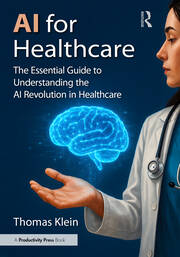
1st Edition
AI for Healthcare The Essential Guide to Understanding the AI Revolution in Healthcare
Table of Contents
Preface
About the Author
Acknowledgements
Introduction
PART A: FUNDAMENTALS
Chapter 1. Understanding the acceleration of Artificial Intelligence
1.1 AI: From science fiction to medical reality
1.2 Behind the scenes of AI: how AI is transforming healthcare
1.3 LLM: the new digital brain
Chapter 2. The AI Agentic paradigm
2.1 ChatGPT: a revolution in the assessment of knowledge
2.2 Cloud computing: the invisible engine of medical innovation
2.3 From chatbots to AI agents: the next step
2.4 LLM in healthcare: the AI changing diagnosis and treatment
Chapter 3. AI in Healthcare: a delicate revolution with high stakes
3.1 Healthcare: a sensitive field, an inevitable transformation
3.2 Building trust: the ethical challenges
3.3 The human role in the AI era: towards synergistic collaboration
3.4 Values-driven AI: succeeding in responsible innovation
Chapter 4. Medical data: fueling innovation in healthcare
4.1 Medical data: the hidden power behind AI
4.2 Digital twins: artificial intelligence serving patients
4.3 Synthetic data: powerful potential for medical research
PART B: REAL-WORLD APPLICATIONS
Chapter 5. Revolutionizing diagnosis and medical imaging
5.1 Augmented diagnosis: a new era for medical imaging
5.2 Augmented eyes: when AI sees the invisible
5.3 Global success stories: AI-pioneering hospitals
5.4 Between brilliance and bias: AI in imaging
Chapter 6. Predictive medicine: anticipating to save lives
6.1 Predicting to cure: medicine of the future
6.2 Detecting the invisible: AI on the front line
6.3 Predictive revolution: real cases in AI-assisted medicine
6.4 Tomorrow's health: creating a predictive ecosystem
6.5 Protecting and supporting: AI serving humanity
Chapter 7. AI agentic approach to revolutionize personalized care
7.1 The medical AI agent: first steps in medical assistance
7.2 Augmented research: AI agents in the laboratory
7.3 AI for personalized care: supporting clinical decisions
7.4 The multi-agents approach
7.5 AI and humans: an indispensable duo for the future of healthcare
Chapter 8. Connected health: a digital revolution for all
8.1 Wearables: transforming everyday health tracking
8.2 From data to decision: AI transforming healthcare
8.3 Adaptive AI: understanding and anticipating your health
8.4 Participatory health: how AI is changing the role of caregivers
8.5 Incredible potential for all
8.6 Connected devices and health data: the privacy paradox
Chapter 9. AI serving hospitals
9.1 Hospital revolution: how is AI optimizing care and management
9.2 AI at the heart of diagnosis: improving precision and speed
9.3 The future of hospitals: AI as a pillar of innovation
9.4 The augmented hospital: where technology meets humanity
Chapter 10. Digital therapies: a new era for mental health
10.1 Silent revolution: AI changing mental health
10.2 AI: a powerful partner in mental healthcare
10.3 Concrete examples of digital therapies in mental health
10.4 Mental health: the challenges and limits of digital therapies
10.5 Navigating the challenges: AI and technical issues in mental healthcare
Chapter 11. AI and disability: towards greater autonomy
11.1 Inclusion and technology: how AI is redefining accessibility
11.2 AI supporting inclusion: solutions for DYS and ASD disorders
11.3 Neural implants: promises and perspectives
11.4 Casey Harrell, a voice restored through AI
11.5 Inclusive AI: democratizing access to technological innovation
PART C: RESPONSIBLE IMPLEMENTATION
Chapter 12. Building trust: ethics at the heart of AI in healthcare
12.1 The Hippocratic Oath in the digital age
12.2 Innovating ethically: AI for responsible medicine
12.3 Augmented medicine: an ethical vision for the medical future
12.4 Adopting AI sustainability: ethics as an essential pillar
Chapter 13. Cybersecurity and AI
13.1 Cybersecurity and AI: protecting medical data for a secure future
13.2 Anticipating threats: AI for data security
13.3 AI as a copilot in the security center
13.4 The invisible war: AI defending against cyber threats
13.5 Protecting together: AI and cybersecurity, a collective challenge
Chapter 14. Emerging technologies and the future of healthcare
14.1 Technological convergence: towards integrated smart medicine
14.2 Modularity and intelligence at the heart of care
14.3 Quantum computer: the new frontier of medical computing
14.4 AI as a shield against health crises
14.5 A time for bold choices
14.6 Involving citizens for an inclusive future
Chapter 15. The support system: AI powering what happens before and around care
15.1 AI in the emergency response chain
15.2 The invisible backbone: AI and hospital supply chains
15.3 Training the next generation: AI in medical education
15.4 The home as an extension of the hospital with AI
CONCLUSION: Together for Tomorrow’s Health
Biography
Thomas Klein is an expert in artificial intelligence. Based in the United States, he supports organizations worldwide in their strategic adoption of AI, with particular expertise in the digital transformation of the healthcare sector. An engineering graduate of Télécom Nancy, Thomas Klein completed his education with several high-level training courses in France and abroad. He studied at the University of Leicester in the United Kingdom. He began his career as a consultant, contributing to major digital transformation projects for the French government. He then served as Director of Digital Transformation, leading projects for European institutions. He also trained in artificial intelligence applied to healthcare at MIT and Harvard with certification programs. These courses reinforce the expertise he has acquired in the field through numerous projects deployed in hospitals and healthcare organizations. His commitment to AI in healthcare was demonstrated with the implementation of the first global solution combining mixed reality and artificial intelligence to help autistic children develop their social skills. This innovation illustrates his vision of technology truly serving human well-being and inclusion. With solid experience in digital transformation gained in a variety of environments, Thomas Klein joined Microsoft France in 2020. His arrival coincided with the acceleration of AI, ideally positioning his expertise at the heart of this technological revolution. At Microsoft France, his achievements earned him several awards, including the Platinum Award and the Technology Solution Excellence Award. These accolades testify to his ability to orchestrate complex transformations and guide customers toward successful AI adoption, particularly in the healthcare sector. He has spoken at HIMSS, the world's leading healthcare and innovation trade show, to present his vision of AI in hospitals. Alongside his role at Microsoft, Thomas Klein put his expertise to work for the common good as a municipal councilor to the Mayor of Suresnes, in charge of Responsible Artificial Intelligence. In this role, which is unique in France, he spearheaded a pioneering approach to integrating AI into local public services, notably organizing the first conference on "AI and My City." This experience gave him an intimate understanding of the challenges of accessibility and ethics in AI for all citizens. Based in the United States since 2024, Thomas Klein has been putting his expertise at the service of organizations around the world. His mission: to support them in building a strategic vision of responsible AI and harness its full potential. His career path reflects a deep conviction: technology must serve humanity. This multidimensional experience, combining technical innovation, strategic vision, and ethical commitment, makes him a leading voice for deciphering the issues, opportunities, and challenges of artificial intelligence in the transformation of the healthcare sector.
