




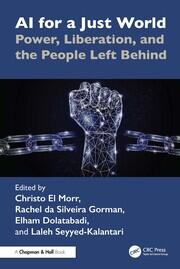
1st Edition
AI for a Just World Power, Liberation, and the People Left Behind
Part I: AI, Equity, and Health Justice
Chapter 1. Artificial Intelligence and the Pursuit of Equity: A Scoping Review of Benefits, Harms, and Gaps
Prateeksha Pathak, Nicole Zhang, Ayissha Pavakopethan, Amir Bayat, and Christo El Morr
Chapter 2. Beyond White Skin: The Need for Equitable AI in Healthcare
Janise Peters
Chapter 3. What the AI Doesn’t See: On Fairness Proxies in Medical AI
Elizabeth U. Thompson, Courtney C. Rogers, Krystal A. Porter, Julia Scialla, and Rupa S. Valdez
Chapter 4. Aligning AI for Health Equity: Successes, Gaps, and Barriers in the Canadian Healthcare System
Jenna Cappello, Christo El Morr, and Elham Dolatabadi
Chapter 5. Benchmarking Bias: Expanding Clinical AI Model Card to Incorporate Bias Reporting of Social and Non-Social Factors
Shahram Mohanna, Carolina A. M. Heming, Mohamed Abdalla, Monish Ahluwalia, Linglin Zhang, Hari Trivedi, MinJae Woo, InChan Hwang, Benjamin Fine, Judy Wawira Gichoya, Leo Anthony Celi, and Laleh Seyyed-Kalantari
Chapter 6. Responsible Foundation Models for Healthcare: Risks, Opportunities, and Pathways to Responsibility
Laleh Seyyed-Kalantari, Mojtaba Kolahdouzi, Arash Asgari, Hassan Hamidi, Amirreza Naziri, Artur Parkhimchyk, Seyyed Matin Tavakoli Afshari, Huan Wu, Salamata Konate, and Shahram Mohanna
Chapter 7. Evaluating AI Safety, Hallucinations, Psychosis and Bias Using Clinical Simulations
Elizabeth Marie Borycki and Andre William Kushniruk
Chapter 8. Addressing Structural Bias in AI-Driven Healthcare: From Technical Fixes to Equity-by-Design
Mehdi Adda
Part II: Disability, Education, and Techno-Ableism
Chapter 9. Disability-centered Policy Opportunities and Challenges for Accessible and Inclusive AI: A Scoping Review
Christo El Morr, Sabine Fernandes, Damanjot Singh, Vaibhav Sawhney, Rachel Gorman, and Yahya El-Lahib
Chapter 10. Rethinking Artificial Intelligence for Sickle Cell Disease – A Bounded Justice and Disability Justice Approach
Vanessa Ferguson
Chapter 11. Beyond ‘Technoableism’: AI, Ableism, and Accommodations in Postsecondary/STEM Education
Sammy Jo Johnson, Yoonmee Han, Nolan Krahn, and Maverick Smith
Chapter 12. AI, Technoableism, and Computing Education: Assessing Conceptual Entry Points
Melanie Baljko
Chapter 13. Artificial Intelligence, Social Media, and People with Disabilities: A Critical Review
Hannah Bullock, Naleni Jacob, and Christo El Morr
Chapter 14. Epistemic Injustice and Disability-Evasiveness
Ryan B. Collis, Ellouise Van Berkel, Katherine Barron, and Aaron Richmond
Part III: AI in Society: Gender, Labor, and Relations
Chapter 15. Misogyny by Design: The Manosphere, AI, and Technology-Facilitated Gender-Based Violence
Sonia D’Angelo
Chapter 16. Intimate Inequities: Examining the Benefits and Risks of AI in Online Dating for Marginalized Populations
Christopher Dietzel
Chapter 17. AI and Social Reproduction: Social Structures of Dominance and Control
Shruti Raji-Kalyanaraman
Part IV: Governance, Power, and Bias in AI Systems
Chapter 18. No More Radical Ethical Uncertainty: GenAI and Higher Education within Structures of Capital
Gabi Schaffzin and Jessica Vorstermans
Chapter 19. A Cognitive Usability Engineering Approach to Understanding Bias in Human-AI Interaction
Andre William Kushniruk and Elizabeth Marie Borycki
Chapter 20. Toward a Leftist Artificial Intelligence for Geopolitical Analysis: Reconsidering the Technical and Conceptual Aporias in the Development of Radically Equitable Artificial Agents
Fouâd Oveisy
Chapter 21. Algorithmic Border Securitization: The Datafied Migrant at the Canada-U.S. Border
Mina Mir and Andrea Lachmansingh
Chapter 22. Disablement by Algorithm: AI as a Modern Tool of Settler-Colonial Violence in Palestine
Amanie Issa and Christo El Morr
Part V: Decolonial and Philosophical Critiques of AI
Chapter 23. Unsettling Realities of AI Equity: Colonial Modernity in Action
Maimuna S. Khan and Yahya El-Lahib
Chapter 24. Deconstructing AI’s Religious Code: From Colonial Conquest to Unconditional Hospitality for Indigenous Relational Epistemologies
Michael G. Sherbert
Chapter 25. Digital Beings or Mere Tools? Animist and Posthumanist Approaches to AI Companion Rights
Kathleen Cherrington
Chapter 26. The Use of AI in the Palestinian Genocide: A Marxist Analysis
Jude Kadri
Chapter 27. AI and Equity: Thinking About the Modern Identity and the Uncanny “There”
Anoop George
Chapter 28. Beyond the Algorithm—Toward a Just and Liberatory Future
Christo El Morr, Elham Dolatabadi, Laleh Seyyed‑Kalantari and Rachel da Silveira Gorman
Biography
Christo El Morr, PhD, is Professor of Health Informatics and Director of the Centre for Feminist Research at York University, Toronto. His Equity Informatics research spans equity AI, patient-centered virtual care, mental health, global health promotion, and disability rights monitoring. He is also a theologian, poet, and novelist.
Rachel da Silveira Gorman, PhD, is Professor and Director of the Graduate Program in Critical Disability Studies at York University. Gorman’s current projects focus on codesign and community-based AI applications; biochemical and cellular mechanisms of health inequity; social movement learning in the context of AI and data justice; and metabolizing collective fear through poetry.
Elham Dolatabadi, PhD, is an Assistant Professor and Tier-2 Connected Minds York Research Chair in Safe AI for Health Equity at York University, and a faculty affiliate at the Vector Institute. Her contributions to date have advanced the design of AI systems that collaborate with humans in high-stakes health decision-making through agentic designs, multimodal representations, reasoning, orchestration mechanisms, and novel evaluation frameworks.
Laleh Seyyed-Kalantari, PhD, is an Assistant Professor at York University’s Lassonde School of Engineering and a faculty affiliate at the Vector Institute. She leads the ResponsibleAI Lab, focusing on AI safety, bias, and interpretability, using generative and foundation models to promote equitable, culturally aware AI across health and societal domains.
