




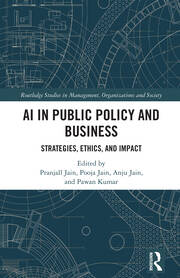
1st Edition
AI in Public Policy and Business Strategies, Ethics, and Impact
PART I — FOUNDATIONS & STRATEGIC INFRASTRUCTURE
Chapter 1: AI-as-an-Asset: Strategic Infrastructure for Governance and Enterprise Systems
Pranjall Jain, Pooja Jain, Dr. Anju Jain
Chapter 2: Adaptive AI Systems: Evolution from Narrow to Agentic Intelligence for Institutional Agility
Ashwaria Mahajan, Sunil Kumar
PART II — AI IN PUBLIC POLICY & GOVERNANCE
Chapter 3: AI for Social Welfare: Policy Frameworks for Ethical and Responsible AI in India, Lithuania, Slovenia, Estonia, and the United Kingdom
Nirbhay Sharma, Shabnam Gulati
Chapter 4: AI for Public Service Delivery: Strategic and Cross-Sector Models from Zambia
Shashi Kant, M. Mahesheswaran, Pawan Kumar
Chapter 5: AI for Environmental Policy and Climate Governance
Avtar Singh, Dalwinder Kaur Dhillon
Chapter 6: AI for Sustainable Mobility Systems: A Systematic Review (2010–2025)
Shyam Sunder Agrawal, Arpit Tiwari, Saloni Raheja
Chapter 7: AI for Education: Augmenting Pedagogy, Creativity, and Institutional Learning Systems
Pardeep B Sharma, Pankaj Kathuria, Rasna Pathak
PART III — AI IN BUSINESS STRATEGY & ENTERPRISE TRANSFORMATION
Chapter 8: AI in Strategic Management: Value Creation, Institutional Scale, and Competitive Advantage
J John Manoharan, E Sylvia
Chapter 9: AI For Human Capital Governance: Exploring the Role of Conversational AI For Workforce Transformation
Aaliya Ashraf, Sushant Gupta, Nancy Sahni, Ulfat Andrabi
Chapter 10: AI for Customer Experience Systems: Intelligent Interfaces, Service Optimization, and Experience Design
Priyanka Jarolia, Anjali Bhute
Chapter 11: AI in Financial Systems: Risk Intelligence, Compliance, and Sectoral Transformation
Gurdas Singh, Mehakdeep Kaur Sidhu
Chapter 12: AI For Actuarial Intelligence: Data-Driven AI Architecture for Insurance Systems
Santujit Chanda, Seema Sharma
Chapter 13: AI in Consumer Intelligence Systems: Behavioral Analytics, Demand Sensing, and Market Foresight
Vikas Kumar, Preeti
Biography
Pranjall Jain, PhD, CA, CS, B.Com (Hons.), AICA, is a specialist in organizational analysis and applied artificial intelligence. He is a civil servant, working with the Government of India. He has served as a special invitee to the Board of Studies, Institute of Chartered Accountants of India (ICAI).
Pooja Jain is a global AI expert, thought leader, international author, and speaker. She works as a solutions specialist at Google, US, and has completed her education from Stanford University, Stanford, California, US, and University of California Berkeley, Berkeley, US. She is the Distinguished Alan Turing Chair Professor at Centre of Excellence for Advanced Artificial Intelligence (CoEAAI). She is the cofounder of the Theory of HR Quantification and a much sought-after speaker on AI and its applications.
Anju Jain is a Professor at University of Delhi. In her multifaceted tenure, she has assumed diverse roles, each leaving a profound imprint on the university’s journey forward. As a trailblazer of inclusive education and ground-breaking research, she has authored 170 research papers, articles, and books and has presented high-impact research papers at more than 100 international conferences.
Pawan Kumar is Professor in the Department of Marketing at Mittal School of Business, Lovely Professional University, Punjab, India. With 15 years of experience in business academic research, his interests span entrepreneurship, marketing, e-commerce, consumer behavior, and marketing research.
“AI in Public Policy and Business: Strategies, Ethics, and Impact arrives as both timely and essential. What distinguishes this work is its ability to bridge domains that are too often treated in isolation while presenting them in a language accessible to practitioners, policymakers, and scholars alike. By situating AI within the broader architecture of governance and commerce, the book illuminates the pathways through which emerging technologies can augment policy design and catalyse inclusive growth. The editors have done a commendable work by equipping the readers with a comprehensive understanding of the opportunities and challenges that define today’s AI landscape.”
Neha Jain IAS, Indian Administrative Service, Special Secretary to the Government of Uttar Pradesh IT and Electronics Department, Managing Director, Uttar Pradesh Development Systems Corporation Ltd. (UPDESCO)
“AI in Public Policy and Business: Strategies, Ethics, and Impact serves as an important resource for decision-makers across sectors who are seeking clarity amidst the rapid proliferation of AI applications. Its analytical depth, combined with its strategic relevance, makes it a valuable guide for those who are shaping the future of governance and organisational leadership. What makes this book particularly relevant is its balanced approach: it neither romanticises technology nor dismisses its transformative potential. Instead, it examines AI with the realism required of public systems. I commend the Editors, Dr. Pranjall Jain, Pooja Jain, Dr. Anju Jain, Dr. Pawan Kumar, who have crafted a text that combines academic rigour with practical orientation. Their interdisciplinary vision ensures that the book speaks to multiple stakeholders with clarity and purpose.”
Babloo Kumar IPS, Indian Police Service, Joint Commissioner of Police (Law and Order), Police Commissionerate, Lucknow, Uttar Pradesh
“I extend my appreciation particularly to Dr. Pranjall Jain and Ms. Pooja Jain for their meticulous stewardship and their ability to harmonise diverse voices, synthesise complex ideas, and maintain a high standard of scholarship. I believe this book will contribute meaningfully to ongoing conversation on technology, governance, and institutional capacity-building. It offers a thoughtful foundation for those who are working to create intelligent systems that are technologically progressive, operationally resilient, and socially responsive.”
Qazi Mairaj Ahmed IRSE, Indian Railway Service of Engineers, Additional Director General, Research Designs and Standards Organization, Fellow of The Institution of Civil Engineers (FICE UK)
