




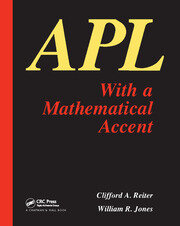

This book provides an introduction to the computer language A Programming Language (APL), providing quick access to the powerful computational capabilities of the language for the newcomer to APL. It focuses on the mathematical nature of the language, and complements standard curricula.
First Steps With APL
Interacting with APL
Order of Execution
Negative Sign, Minus Sign
Assignment and Variable Names
Example: Heron’s Formula
The Equals Function
Examples: Right Triangle Test, Conditional Incrementing
Dyadic, Monadic Functions
Functions with Vector Arguments
Examples: Some Uses of Vector Arithmetic
Shape, Reduction Operator
Examples: Average, Dot Product
More on the Reduction Operator
Index Generator
Examples: A Partial Sum, A Sequence for e
Number Forms and Print Precision
Workspaces, System Commands
Exiting APL
Exercises
Fundamentals of Arrays
Example: Polynomial Evaluation
Elementwise Arithmetic
Reshape: Defining Arrays
Reduction
Outer Product
Example: Evaluation of Polynomials at Several Points
Catenation
Catenation of Matrices
Example: Forming a Blockwise Diagonal Matrix
Catenation of Matrices with Vectors
Indexing
Example: Elementary Row Operations on Matrices
Shape
Empty Arrays
Exercises
Elementary Function Definition
Function Definition
Example: A Function for Polynomial Evaluation
Example: Approximating Areas Using Right-Hand Endpoints
Random Integers, Random Reals
Correcting a Function Line
Commands for Editing Functions
Suspended Functions; Interrupts
System Commands
Branching: Simple Loops
Example: Newton’s Method
Statement Separation, Diamond
Explicit Output
Example: Fibonacci Numbers
Exercises
Matrix Algebra
Matrix Product
Example: Markov Processes
Solving Linear Systems Matrix Divide
Example: Some Solutions of Linear Systems
Outer Product
Example: Polynomial Interpolation
Example: Polynomial Evaluation Revisited
Least-Squares Solutions of Linear Systems
Example: Least-Squares Polynomial Curve Fitting
Matrix Inverse
Matrix Transpose
Example: A Formula Using Transpose
Example: Gram-Schmidt Orthogonalization
Example: Testing for Orthonormality
The Power Method
Exercises
Data Comparison and Logical Functions
Relational Functions: Comparatives
Example: Averages on Selected Scores
Logical Functions
Example: Frequency Distribution
Generalized Inner Product: Vectors
Example: Weighted Average
Generalized Inner Product: General Arrays
Example: Paths in Graphs
Floor, Ceiling
Example: Rounding to a Decimal Position
Membership Function
Comparison Tolerance
Exercises
Simulation and More Mathematical Functions
Roll, Deal, and Random Link
Example: Matching Partners
Example: Simulating A Classical Probability Experiment
Example: Polya’s Urn Scheme
Factorial and Binomial
Example: Binomial Distribution
Example: Polynomial Translation
Trigonometric Functions
Example: Monte Carlo Integration
Exercises
Statistics and Graphics
Mean and Standard Deviation
Maximum and Minimum
Example: Range
Grade Up
Example: Median
Character Arrays
Example: Frequencies
Example: Histograms
Replicate on Vectors
Example: Separating Data
Scan
Example: Cumulative Histogram
Plotting X-Y Points
Example: Least-Squares Line Fitting
Sampling
Example: Sampling from an Exponential Population
Example: Sampling from a Binomial Distribution
Example: Sampling from a Normal Population
Exercises
More Array Manipulation
Take and Drop Vectors
Example: Polynomial Addition
Take and Drop on Matrices
Ravel Replicate, Compression, and Expansion
Example: Constructing Data with a Given Distribution
Reverse
Rotate
Example: Polynomial Multiplication
Dyadic Transpose
Transpose on Higher Dimensional Arrays
Laminate
Example: Constructing Banded Matrices
Exercises
Sorting and Coding
Grade up, Grade Down
Grade up, Grade Down on Matrices
Example: Manipulation of Grade Point Average Statistics
Index Relative to a Vector
Example: Alphabetization
Example: Removing Duplicated and Frequency Revisited
Index Origin
Example: Polynomial Evaluation in Both Index Origins
Residue: Modular Reduction
Example: Finite Field Tables
Example: Alphabetization with Mixed-Case Letters
Represent
Base Value
Example: Polynomial Evaluation, Finis
Represent and Base Value on Arrays
Atomic Vector
Example: Encoding a String into Binary
Example: Hamming Code for Error Correction
Example: Hamming Code on Natural Text
Exercises
More Function Definition
Functions for Programming Uses
Example: Descriptive Statistics
Branching
Line Labels
Example: Aggregating Preferential Ballots
Multioption Branches
Example: The Bisection Method
Recursive Functions
Example: Generating Permutations
Example: Adaptive Integration
Quad: Input and Output
Quote-Quad: Input and Output
Example: Entering a Matrix Name-List
Example: More Adaptive Integration
Format
Example: Formatting an Interest Table
Execute
Example: Entering a Matrix Name-List, Revisited
Example: Matrix to a Power-of-2 Power
Functions as Arguments of Functions
Exercises
Appendix A
Help, Error Messages, and Debugging
A.1 Surprises for New Users
A.2 Error Messages
A.3 Suspended Functions
A.4 Example: Debugging with Quad Output
A.5 Setting Traces and Stops
Appendix B
Workspace Environment
B.1 Workspace Contents: Saving and Loading
B.2 Workspace Management
B.3 System Commands
B.4 System Variables
B.5 System Reports and System Functions
Appendix C
Keyboards
Appendix D
Answers to Selected Exercises
Bibliography
References
Index
Biography
Reiter, C.A.
