



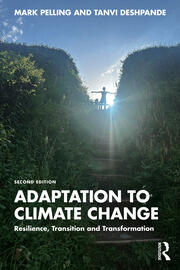
2nd Edition
Adaptation to Climate Change Resilience, Transition and Transformation
PART I
Framework and theory
1 The adaptation age
Adapting to climate change
The idea of adaptation
The IPCC–UNFCCC frame
The costs of adapting
Conceptual development
Structure of the book
2 Understanding adaptation
An adaptation lexicon
The antecedents of adaptation
Cybernetics
Coevolution
Adaptive management
Coping mechanisms
Adaptation as a contemporary development concern
A typology of adaptation
Resilience and adaptation
Adaptation thresholds
Evaluating adaptive choices: economics and ethics
Three visions of adaptation: resilience, transition and transformation
PART II
The resilience–transition–transformation framework
3 Adaptation as resilience: social learning and self-organisation
A vision of adaptation as resilience
Framing of resilience
Social learning
Self-organisation
Organisations as sites for adaptation
Pathways for organisational adaptation
Conclusion
4 Adaptation as transition: risk and governance
A vision of adaptation as transition
Governance and transition
Socio-technical transitions
Urban regimes and transitional adaptation
Conclusion
5 Adaptation as transformation: risk society, human security and the social contract
A vision of adaptation as transformation
Modernity and risk society
The social contract
Human security
Disasters as tipping points for transformation
Conclusion
PART III
Living with climate change
6 Adaptation within organisations
Context: policy and methods
Case study analysis
The Environment Agency
Grasshoppers farmers’ group
Conclusion
7 Adaptation as urban risk discourse and governance
Context: policy and methods
Case study analysis
Cancun
Playa del Carmen
Tulum
Mahahual
Conclusion
8 Adaptation as national political response to disaster
Context: policy and methods
Case study analysis
1970, East Pakistan (Bangladesh): the Bhola Cyclone and the politics of succession
1998, Nicaragua: Hurricane Mitch, a missed opportunity for transformation
2005, New Orleans, USA: transformation denied by political dilution
Conclusion
PART IV
Adapting with climate change
9 Conclusion: adapting with climate change
How to adapt with climate change?
Diversify the subject and object of adaptation research and policy
Focus on social thresholds for progressive adaptation
Recognise multiple adaptations: the vision effect
Link internal and external drivers of adaptation
A synthesis of the argument
The age of adaptation
The adaptation tapestry
The resilience–transition–transformation framework
Sites of adaptive action
From theory to action
Biography
Mark Pelling is Professor of Risk and Disaster Reduction, Department of Risk and Disaster Reduction, University College London and before this at King’s College London, the University of Liverpool and University of Guyana. His research and teaching focus on human vulnerability and adaptation to natural hazards and climate change. He has served as a lead author with the IPCC and as a consultant for UNDP, DFID and UN-HABITAT amongst others.
Tanvi Deshpande is a Fellow with the Birmingham Institute for Sustainability and Climate Action, University of Birmingham and a visiting fellow at the London School of Economics and Political Science.
