




1st Edition
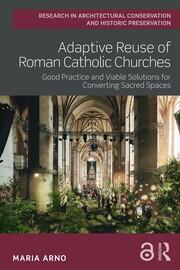
Adaptive Reuse of Roman Catholic Churches Good Practice and Viable Solutions for Converting Sacred Spaces
List of figures
Acknowledgements
Preface
Chapter 1. Research context and aims
Chapter 2. Theoretical framework and historical context of church reuse
Chapter 3. Theological reflections and ecclesiastical principles on the interior and adaptation of Roman Catholic Churches
Chapter 4. Religious landscape and church property management in the Netherlands, Belgium, Germany, and Poland
Chapter 5. Case Studies
Chapter 6. Discussion and final conclusions
Index
Biography
Maria Arno (PhD) is an architect and Assistant Professor in the Faculty of Architecture at Warsaw University of Technology. She earned both her MA degree in Architecture and Urban Planning (2016) and her PhD (2023) from the same institution. Her work focuses on sacred and monumental architecture, and she is the author of articles and scholarly publications on the adaptive reuse of churches, monument preservation, and sustainable architectural development. She is a member of Future for Religious Heritage, the European Academy of Religion, and the ICOMOS Poland Committee on the History and Conservation of Sacred Architecture.
“The issue of repurposing decommissioned churches is a complex challenge, as it touches on sensitive aspects not only from a theological standpoint, but also from social and economic perspectives. Maria Arno’s book serves as a valuable resource for professionals and scholars seeking both theoretical insight and practical guidance. The historical perspective helps to temper the sense of urgency, while the design perspective aids in evaluating concrete implementations.”
Andrea Longhi, Full Professor of History of Architecture at the Politecnico di Torino and a member of the ICOMOS–PRERICO Italian Committee. He advised the Pontifical Council for Culture on research and the implementation of the Guidelines for the Decommissioning and Ecclesial Reuse of Churches (2018).
