
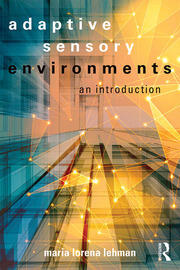
1st Edition

Adaptive Sensory Environments An Introduction

By Maria Lorena Lehman Copyright 2017
202 Pages 29 B/W Illustrations
by Routledge

202 Pages 29 B/W Illustrations
by Routledge

202 Pages 29 B/W Illustrations
by Routledge

***WINNER OF A NAUTILUS 2017 SILVER MEDAL BOOK AWARD*** Adaptive Sensory Environments: An Introduction presents a cutting-edge methodology for adaptive sensory design by fostering an inter-disciplinary approach in which aspects of neuroscience, biophilia, captology, nanotechnology, kinetics, and sensemaking all play critical roles in helping adaptive architecture "tune" to occupants.... Read more
Acknowledgments.  Introduction.  1. Counter-Productive Design  2. Living Information  3. Kinetic Frontiers  4. Unfolding Transience  5. Spatial Dynamics  6. Building Perceptions  7. Design for the Senses  8. Architecture That Learns  9. Architecture That Teaches  10. Plasticity for Growth  11. Nano Possibilities  12. Building Personalization  13. Influence by Design  14. Transformation to Fulfillment  15. Authoring Adaptive Systems  16. Integrating Nature  17. Overarching Goals  18. Success Factors  19. Collective Behaviors  20. Network Communication  21. Design Process  22. Design Capabilities  23. Spirit of Place  24. Future Impact  Bibliography.  Index

Biography

Maria Lorena Lehman is the Founder of the Sensing Architecture ® Academy. She is recipient of the Harvard University Digital Design Prize, and holds degrees from both Virginia Polytechnic Institute, US and the Harvard University Graduate School of Design, US. Lehman is internationally published and in numerous periodicals, including Architect Magazine and Forbes. To learn more, visit SensingArchitecture.com.

'Maria Lorena Lehman has established a formidable international reputation as a researcher and teacher of multi-sensory design. All her work is devoted to enhancing the human experience when working and living in buildings. This book continues to explore this motive and shows her keen awareness of the lessons from the past and current trends in foreseeing the future for architecture. It is full of creative thought. She examines how technology, nature, learning from other design sectors and many other aspects can harness benefits for occupants and in this way transform architectural design. This is a book students, academics and professionals in practice should embrace and I believe will relish.' -  Derek Clements-Croome, Professor Emeritus, School of the Built Environment, Reading University, UK
