




1st Edition
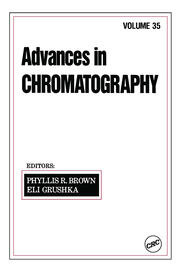
Advances in Chromatography Volume 35
"Volume 35 examines timely subjects such as performance requirements, detection modes, and ancillary techniques for optical detectors in capillary electrophoresis; and more."
Preface
Contributors to Volume 35
Contents of Other Volumes
Optical Detectors for Capillary Electrophoresis
Edward S. Yeung
Introduction
Performance Requirements
Various Detection Modes
Various Ancillary Techniques
Summary
References
Capillary electrophoresis Coupled with Mass Spectrometry
Kenneth B. Tomer, Leesa J. Deterding, and Carol E. Parker
Introduction
Instrumentation
Addressing limitations
Applications
Capillary electrophoresis Coupled with Tandem Mass Spectrometry
Conclusions
References
Approaches for the Optimization of Experimental Parameters in Capillary Zone Electrophoresis
Haleem J. Issaq, George M. Janini, King C. Chan, and Ziad El Rassi
Introduction
Basic Theoretical Concepts
Experimental Variables that Influence Separation Parameter
References
Crawling Out of the Chiral Pool: The Evolution of Pirkle-Type Chiral Stationary Phases
Christopher J. Welch
Introduction
Chirality and Chiral Pool
Production of Enantioenriched Compounds
Beyond the Chiral Pool
Evolution of Brush-type Chiral Stationary Phase Design
Conclusion
References
Pharmaceutical Analysis by Capillary Electrophoresis
Sam F. Y. Li, Choon Lan Ng, Chye Peng Ong
Introduction
Modes of Capillary Electrophoresis
Buffer modifiers
Applications
Comparison with High-Performance Liquid Chromatography
Conclusion
References
Chromatographic Characterization of Gasolines
Richard E. Pauls
Introduction
Compound Class Methods
PIONA Methods
Physical Properties
Benzene
Aromatics
Olefins
Oxygenates
Summary
References
Reversed-Phase Ion-Pair and Ion-Interaction Chromatography
M. C. Gennaro
Introduction
Retention Mechanism in Ion-Pair and Ion Interaction Chromatography
Dependence of Retention on Different Interpedent Factors
Experimental Conditions and Applications
Chemometric Optimization Methods
References
Error Sources in the Determination of Chromatographic Peak Size Ratios
Veronika R. Meyer
Introduction
General Remarks
Contamination Errors
Different Behavior of the Two Compounds
Interconversion of Compounds
Use of Peal Heights Without Calibration
Detector Nonlinearity
Integration Errors
Incomplete Resolution
Conclusions
References
Index
Biography
Phyllis R. Brown is Professor of Chemistry at the University of Rhode Island in Kingston, where she has taught since 1973. The author or coauthor of over 170 journal articles and several books, she edited the volume HPLC in Nucleic Acid Research. She also serves as an editorial board member for the Journal of Liquid Chromatography (both titles, Marcel Dekker, Inc.) and on the Advisory Board of Analytical Chemistry. Dr. Brown received the B.S. degree (1944) in chemistry from George Washington University, Washington, D.C., and the Ph.D. degree (1968) in chemistry from Brown University, Providence, Rhode Island.
Eli Grushka is Professor of Analytical Chemistry at the Hebrew University of Jerusalem in Israel. He is the author or coauthor of over 130 scientific articles in the field of separation science. He is the editor or co-editor of several books, including New Developments in Separation Science and Preparative Scale Chromatography and he serves on the editorial boards of several journals, including Separation Science and Technology and Analytical Letters (all titles, Marcel Dekker, Inc.). Dr. Grushka received the B.S. degree (1963) from Long Island University, Brooklyn, New York, and the Ph.D. degree (1968) from Cornell University, Ithaca, New York.
"The overall quality of the chapters in this collected volume is quite high, and each chapter would be greatly beneficial to anyone needing a quick introduction into one of the areas covered. Any library maintaining the series should definitely acquire volume 35. "
---Journal of Pharmaceutical and Biomedical Analysis
". . .All of the reviews presented in this volume are not only pleasant to read but they offer a good survey of the latest achievements in the field. . .the editors should be congratulated for a well done job. For its price the volume is a good buy. "
---Journal of Chromatography A
"This volume will make an excellent addition to any analytical chemist's collection. "
---Journal of the American Chemical Society
". . .Another thoroughly recommended reference volume for the chromatographer. "
---Analyst
