




1st Edition
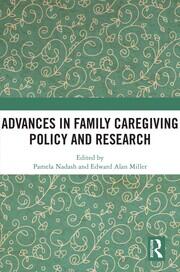
Advances in Family Caregiving Policy and Research
Introduction—Where We Are Now: The State of Family Caregiving Policy
Pamela Nadash and Edward Alan Miller
Section I: Financial and Workplace Security for Family Caregivers
1. Effects of California’s Paid Family Leave Law on Caregiving by Older Adults
Joelle Abramowitz and Marcus Dillender
2. Paid Leave to Meet the Health Needs of Aging Family Members in 193 Countries
Jody Heymann, Amy Raub, Willetta Waisath, Alison Earle, Pamela Stek, and Aleta Sprague
3. A Community Initiative to Engage Employers to Support Caregiving Employees and Build an Advocacy Alliance
Kylie Meyer, Morgan Zachmeyer, Jane Paccione, Cynthia Cardenas, Carol Zernial, and Christina Smith
4. What do Family Caregivers Want? Payment for Providing Care
Pamela Nadash, Eileen J. Tell, and Taylor Jansen
5. Caregivers’ Absenteeism and Its Association With Health Shocks and Functional Impairment Among Persons With Severe Dementia
Chetna Malhotra, Vinh Anh Huynh, Truls Østbye, and Rahul Malhotra
Section II: Interactions Between Caregiving and Formal Services
6. The Relationships Between Informal and Formal Social Care for Older People in England: A Comparison Before and After the Care Act 2014
Jae Yeon Lyu, Bo Hu, Raphael Wittenberg, and Derek King
7. Family Support, Perceived Physical Activeness and Chronic Non-Communicable Diseases as Determinants of Formal Healthcare Utilization Among Older Adults with Low Income and Health Insurance Subscription in Ghana
Williams Agyemang-Duah, Joseph Asumah Braimah, Dennis Asante, Joseph Oduro Appiah, Prince Peprah, Kofi Awuviry-Newton, Anthony Acquah Mensah, Justice Ofori-Amoah, and Kwabena Opoku
8. Improving Transitions in Care for Patients and Family Caregivers Living in Rural and Underserved Areas: The Caregiver Advise, Record, Enable (CARE) Act
Joan M. Griffin, Brystana G. Kaufman, Lauren Bangerter, Diane E. Holland, Catherine E. Vanderboom, Cory Ingram, Ellen M. Wild, Ann Marie Dose, Carole Stiles, and Virginia H. Thompson
9. Family Caregivers as Employers of Migrant Live-In Care Workers: Experiences and Policy Implications
Daniella Arieli and Inbal Halevi Hochwald
Section III: Painting a Portrait of Family Caregiving
10. Older Caregivers: Who They Are and How to Support Them
Sarah E. Petry, Luz Lara, and Nathan A. Boucher
11. The Economic Value of Caregiving in Chile
Pablo Villalobos Dintrans, Javiera Gazmuri, and Carolina Velasco
12. Informal Caregiver Social Network Types and Mental Health: The Mediating Role of Psychological Resilience
Pildoo Sung, Jeremy Lim-Soh, and Rahul Malhotra
13. Leveraging Existing Datasets to Advance Family Caregiving Research: Opportunities to Measure What Matters
Rebecca M. Goodwin, Rebecca L. Utz, Catherine E. Elmore, Katherine A. Ornstein, Djin L. Tay, Lee Ellington, Ken R. Smith, and Caroline E. Stephens
Biography
Pamela Nadash is Professor in the Department of Gerontology and Fellow in the Gerontology Institute at the Donna M. and Robert J. Manning College of Nursing and Health Sciences at the University of Massachusetts Boston, USA. Her research centers on policies that enable people with long-term care needs to live in the community. One model of special interest is managed long-term care; she has also been heavily involved in consumer-directed services. Dr. Nadash is a Fellow of the Gerontological Society of America and Book Review Editor of the Journal of Aging & Social Policy. She serves as a Leadership Council Member at the National Consumer Voice for Quality Long-Term Care, a leading national organization advocating on behalf of people needing long-term services and supports (LTSS), and as Co-Chair of the Long-Term Care Discussion Group, which holds monthly meetings featuring topics in LTSS.
Edward Alan Miller is Professor and Chair in the Department of Gerontology and Fellow in the Gerontology Institute at the Donna M. and Robert J. Manning College of Nursing and Health Sciences at the University of Massachusetts Boston, USA, and Adjunct Professor of Health Services, Policy and Practice at the School of Public Health, Brown University, Providence, USA. His research focuses on understanding the determinants and effects of public policies and practices affecting older adults in need of long-term services and supports. He is the author/co-author/editor/co-editor of more than 155 journal articles, 22 book chapters, and 9 books. Dr. Miller is a Fellow of the Gerontological Society of America and 2024 awardee of the Maxwell A. Pollack Award for Contributions to Healthy Aging, which recognizes an individual who has distinguished themselves by bridging the worlds of research, policy, and practice. He is Editor-in-Chief of the Journal of Aging & Social Policy.
