





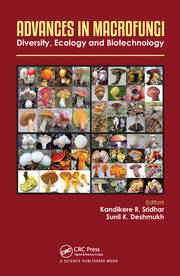
1st Edition
Advances in Macrofungi Diversity, Ecology and Biotechnology
Part 1: Diversity and distribution. 1. Diversity and distribution of macrofungi. 2. Diversity and distribution of termitomycetes. 3. Diversity of coprophyllus macrofungi. 4. Diversity of Amanitas. 5. Taxonomic approaches to understand Entoloma. Part 2: Ecology. 6. Ecology of mycorrhizal fungi. 7. Ecology of termitomycetes. 8. Mycophagy in animals. 9. Aminatas in tropical region. 10. Substrate preference of macrofungi. Part 3: Nutraceuticals and metabolites. 11. Nutritional potential of edible wild mushroom. 12. Bioactive potential of edible wild mushroom. 13. Hallucinogenic macrofungi . 14. Degradation of lignocellulosic wastes. 15. Macrofungi in combating human ailments. Part 4: Association. 16. Mycorrhizal fungi in tree species. 17. Role of mycorrhizal fungi in forestry. 18. Association of mushrooms with termites. 19. Insect inhabiting macrofungi. 20. Tripartite association of macrofungi. Part 5: Cultivation and conservation. 21. Techniques of cultivation of mushrooms. 22. Methods of preservation of macrofungi. 23. Ex situ conservation of macrofungi. 24. In situ conservation of macrofungi. 25. Molecular approaches to conserve macrofungi
Biography
Kandikere R. Sridhar is Senior Professor in the Department of Biosciences, Mangalore University with 40 years of teaching and research experience and has a UGC-BSR Faculty Fellowship. His main area of research is ‘Diversity and Ecology of Fungi of the Western Ghats and Mangrove/Marine Habitats of the West Coast of India’. He was NSERC postdoctoral fellow/visiting professor in Mount Allison University, Canada; Helmholtz Centre for Environmental Research-UFZ and Martin Luther University, Germany and Center of Biology, University of Minho, Portugal. He was recipient of The Shome Memorial Award (2004) and has been Vice-President (2013) and President (2018) of the Mycological Society of India. He was also recipient of The Fellow of Indian Mycological Society, Kolkata (2014), Distinguished Asian Mycologist (2015) and Outstanding Leader in Education and Research, Association of Agricultural Technology of Southeast Asia (2016). He has over 300 publications and has edited four books.
Sunil K. Deshmukh is a Fellow and Area convener at the TERI-Deakin Nano-Biotechnology Research Centre, The Energy and Resources Institute (TERI), New Delhi, India and Adjunct Associate Professor, Deakin University Australia. He was Assistant Director (Natural Products) at the Piramal Enterprises Ltd., Mumbai and also served as Senior Research Scientist at the Hoechst Marion Roussel Ltd., Mumbai. He has broad industry experience in the field of applied microbiology. He is a fellow of the Mycological Society of India, Association of Biotechnology and Pharmacy and Society for Applied Biotechnology. He was the president of the Mycological Society of India (2017). He has over 100 publications and holds eight patents. He has also edited eight books on different aspects of mycology.
