





1st Edition
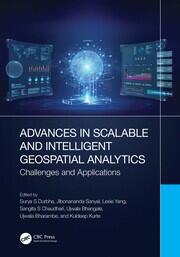
Advances in Scalable and Intelligent Geospatial Analytics Challenges and Applications
Section I: Introduction to Geospatial Analytics
1. Geospatial Technology – Developments, Present Scenario and Research Challenges
Parvatham Venkatachalam
Section II: Geo-Ai
2. Perspectives on Geospatial Artificial Intelligence Platforms for Multimodal Spatiotemporal Datasets
C. V. Krishnakumar Iyer, Swetava Ganguli, and Vipul Pandey
3. Temporal Dynamics of Place and Mobility
Kevin Sparks, Jesse Piburn, Andy Berres, Marie Urban, and Gautam Thakur
4. Geospatial Knowledge Graph Construction Workflow for Semantics-Enabled Remote Sensing Scene Understanding
Abhishek Potnis, Surya S Durbha, Rajat Shinde, and Pratyush Talreja
5. Geosemantic Standards-Driven Intelligent Information Retrieval Framework for 3D LiDAR Point Clouds
Rajat C. Shinde, Surya S Durbha, Abhishek V. Potnis, and Pratyush V. Talreja
6. Geospatial Analytics Using Natural Language Processing
Manimala Mahato and Rekha Ramesh
Section III: Scalable Geospatial Analytics
7. A Scalable Automated Satellite Data Downloading and Processing Pipeline Developed on AWS Cloud for Agricultural Applications
Ankur Pandit, Suryakant Sawant, Rishabh Agrawal, Jayantrao Mohite, and Srinivasu Pappula
8. Providing Geospatial Intelligence through a Scalable Imagery Pipeline
Andrew Reith, Jacob McKee, Amy Rose, Melanie Laverdiere, Benjamin Swan, David Hughes, Sophie Voisin, Lexie Yang, Laurie Varma, Liz Neunsinger, and Dalton Lunga
9. Distributed Deep Learning and Its Application in Geo-spatial Analytics
Nilkamal More, Jash Shah, V.B. Nikam, and Biplab Banerjee
10. High-Performance Computing for Processing Big Geospatial Disaster Data
Pratyush V. Talreja, Surya S Durbha, Rajat C. Shinde, and Abhishek V. Potnis
Section IV: Geovisualization: Innovative Approaches for Geovisualization and Geovisual Analytics for Big Geospatial Data
11. Dashboard for Earth Observation
Manil Maskey, Rahul Ramachandran, Brian Freitag, Aaron Kaulfus, Aimee Barciauskas, Olaf Veerman, Leo Thomas, Iksha Gurung, and Muthukumaran Ramasubramanian
12. Visual Exploration of LiDAR Point Clouds
Satendra Singh and Jaya Sreevalsan-Nair
Section V: Other Advances in Geospatial Domain
13. Toward a Smart Metaverse City: Immersive Realism and 3D Visualization of Digital Twin Cities
Haowen Xu, Andy Berres, Yunli Shao, Chieh (Ross) Wang, Joshua R. New, and Olufemi A. Omitaomu
14. Current UAS Capabilities for Geospatial Spectral Solutions
David L. Cotten, Andrew Duncan, Andrew Harter, Matt Larson, and Brad Stinson
15. Flood Mapping and Damage Assessment Using Sentinel – 1 & 2 in Google Earth Engine of Port Berge & Mampikony Districts, Sophia Region, Madagascar
Penchala Vineeth Kurapati, Ashish Babu, Kesava Rao Pyla, Prasad NSR, and Venkata Ravi Babu Mandla
Section VI: Case Studies from the Geospatial Domain
16. Fuzzy-Based Meta-Heuristic and Bi-Variate Geo-Statistical Modelling for Spatial Prediction of Landslides
Suvam Das, Shubham Chaudhary, Shantanu Sarkar, and Debi Prasanna Kanungo
17. Understanding the Dynamics of the City through Crowdsourced Datasets: A Case Study of Indore City
Vipul Parmar and Anugrah Anilkumar Nagaich
18. A Hybrid Model for the Prediction of Land Use/Land Cover Pattern in Kurunegala City, Sri Lanka
Mohamed Haniffa Fathima Hasna, Mathanraj Seevarethnam, and Vasanthakumary Selvanayagam
19. Spatio-Temporal Dynamics of Tropical Deciduous Forests under Climate Change Scenarios in India
Rajit Gupta and Laxmi Kant Sharma
20. A Survey of Machine Learning Techniques in Forestry Applications Using SAR Data
Naveen Ramachandran, K.K. Sarma, Dibyajyoti Chutia, and Onkar Dikshit
Biography
Dr. Surya Durbha is a Professor at CSRE, Indian Institute of Technology Bombay (IITB). Before joining IITB, he held an adjunct faculty position in the Electrical and Computer Engineering Department at Mississippi State University. He has published over 80 peer reviewed articles and has written a book on the Internet of Things published by Oxford University Press in March 2021.
Dr. Jibonananda Sanyal serves as the Group Leader for Oak Ridge National Laboratory’s Computational Urban Sciences research group. He is an IEEE Senior Member, an ACM Distinguished Speaker, and a 2017 Knoxville’s 40 under 40 honoree.
Dr. Lexie Yang is a lead research scientist in the GeoAI Group at Oak Ridge National Laboratory. She leads several AI-enabled geoscience data analytics projects with large-scale multi-modality geospatial data. The recent work from her team has been widely used to support national-scale disaster assessment and management by federal and local agencies.
Dr. Sangita S. Chaudhari is a Professor in the Department of Computer Engineering, Ramrao Adik Institute of Technology Nerul, Navi Mumbai, India. She is vice chair of IEEE GRSS Mumbai Chapter and has published several journal articles and book chapters.
Dr. Ujwala Bhangale is an Associate Professor in the Department of Information Technology, at K.J. Somaiya College of Engineering, Somaiya Vidyavihar University, Mumbai, India. She has published several papers in IEEE/ACM publications.
Dr. Ujwala Bharambe is an Assistant Professor in the Department of Computer Engineering, at Thadomal Shahani Engineering College, Mumbai, India. She has published several papers in IEEE/ACM publications.
Dr. Kuldeep Kurte is a research scientist in the Computational Urban Sciences Group (CUSG) at Oak Ridge National Laboratory. He has experience working on various applications on different HPC platforms from NVIDIA Jetson Tk1 to the Summit supercomputer.
