




1st Edition
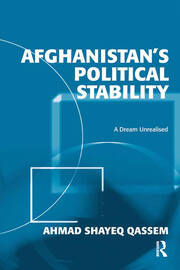
Afghanistan's Political Stability A Dream Unrealised
By Ahmad Shayeq Qassem
Copyright 2010
338 Pages
by
Routledge
338 Pages
by
Routledge
Also available as eBook on:
Political stability has been a central theme of policy for all governments and political systems in the history of modern Afghanistan. Since its inception in the mid-nineteenth century, the country experimented with a diverse succession of political systems and state ideologies matched by few other countries' political histories. In the span of less than nine decades since independence in 1919,... Read more
Introduction; Chapter 1 Afghanistan’s Historic Relations with Central and South Asia; Chapter 2 Ethno-nationalism and Development; Chapter 3 Soviet Occupation and Transformation of Afghan-Pakistan Relations; Chapter 4 The Islamic State of Afghanistan (ISA), the Taliban, and Stability; Chapter 5 Regional Cooperation and Political Stability; Chapter 6 Contemporary Central Asia and Afghanistan’s Stability; concl Conclusion;
Biography
Ahmad Shayeq Qassem, Current Affairs Analyst, UK
'This expertly crafted book examines one of the most persistent problems of Afghanistan’s modern political history, the failure to establish state stability. Identifying the Durand Line border dispute with Pakistan as one of the most critical factors of instability, both internally and externally, it unpacks and analyzes using considerable original data and insights. A timely scholarship of the highest quality with significant policy implications for Afghanistan and international community engaged in establishing peace and stability in the region.' M. Nazif Shahrani, Indiana University, USA 'An objective, nuanced and yet extremely readable study of Afghanistan's political stability and its relations with Pakistan, located within the broader regional and global context, makes this book an essential reading for both practitioners and analysts of regional and global politics.' Samina Yasmeen, University of Western Australia, Australia
