




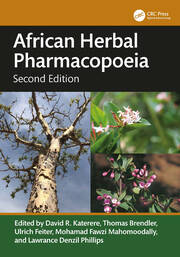
2nd Edition
African Herbal Pharmacopoeia
Preface
About the Editors
List of Contributors
Foreword
Acknowledgements
Editors’ Note
Postword
Chapter 1 High-Performance Thin-Layer Chromatography Procedure
Thi Kieu Tiên Do, Kateryna Khokhlova, Ilona Trettin, and Eike Reich
Chapter 2 Aphloia theiformis (Vahl) Bennett
Emmanuel Rubegeta and David R. Katerere
Chapter 3 Aframomum melegueta K. Schum
Nigel Gericke
Chapter 4 Balanites aegyptiaca (L.) Delile
Manikandan Gurusamy and David R. Katerere
Chapter 5 Boswellia dalzielii Hutch
Naledi Raleie
Chapter 6 Boswellia frereana Birdw
Anjanette DeCarlo, Stephen Johnson, Ahmed Ali, and Manikandan Gurusamy
Chapter 7 Boswellia papyrifera (Del.) Hochst
Anjanette DeCarlo, Stephen Johnson, and Manikandan Gurusamy
Chapter 8 Boswellia sacra Flueck
Anjanette DeCarlo, Stephen Johnson, and Manikandan Gurusamy
Chapter 9 Burkea africana Hook
Iliassou Mouafon Lah, Ntsoaki Anna Nyane, and David R. Katerere
Chapter 10 Cajanus cajan (L.) Huth
Iliassou Mouafon Lah and David R. Katerere
Chapter 11 Carissa edulis Vahl
Nduvho Mulaudzi
Chapter 12 Cleome gynandra Linn
Yvonne Kunatsa and David R. Katerere
Chapter 13 Commiphora myrrha Engl
Cica Vissiennon, Maik Kleinwächter, Bartosz Lipowicz,
Sue Canney Davison, and Abdinasir Abdikadir
Chapter 14 Cryptolepis sanguinolenta (Lindl). Schltr
Ahmed Wahab Obeng and Yaw Duah Boakye
Chapter 15 Garcinia kola Heckel
John Eloyi Judith, Ndiana-Abasi Sunda, and Emeje Martins
Chapter 16 Greyia flanaganii Bolus
Marco Nuno de Canha, Danielle Twilley, Carel Basson Oosthuizen,
and Namrita Lall
Chapter 17 Griffonia simplicifolia Baill
John Eloyi Judith, Ndiana-Abasi Sunday, and Emeje Martins
Chapter 18 Helichrysum odoratissimum (L.) Sweet
Danielle Twilley, Carel Basson Oosthuizen, Marco Nuno de Canha,
and Namrita Lall
Chapter 19 Kigelia africana (Lam.) Benth
Simon Jackson
Chapter 20 Mesembryanthemum tortuosum L
Nigel Gericke
Chapter 21 Myrothamnus flabellifolius Welw
Nigel Gericke
Chapter 22 Pausinystalia yohimbe (K. Schum.) Pierre Ex Beille
Emeje Martins
Chapter 23 Rauvolfia vomitoria Afzel
Oluwaseyi Mayode Aboyade and Abimbola Adepeju Sowemimo
Chapter 24 Ravenala madagascariensis Sonn
Oluwaseyi Mayode Aboyade and Abimbola Adepeju Sowemimo
Chapter 25 Ricinus communis L. var. communis
Chantelle Van Dyk
Chapter 26 Securidaca longepedunculata Fresen
Manikandan Gurusamy and David R. Katerere
Chapter 27 Strophanthus gratus (Wall. & Hook.) Baill
John Eloyi Judith, Ndiana-Abasi Sunday, and Emeje Martins
Chapter 28 Synsepalum dulcificum (Schumach. & Thonn.) Daniell
Manikandan Gurusamy and David R. Katerere
Chapter 29 Tarchonanthus camphoratus L
Iliassou Mouafon Lah and David R. Katerere
Chapter 30 Thaumatococcus daniellii (Benn.) Benth
Iliassou Mouafon Lah and David R. Katerere
Chapter 31 Vitellaria paradoxa C.F. Gaertn
Manikandan Gurusamy and David R. Katerere
Chapter 32 Ximenia caffra Sond
Alfred Maroyi
Index
Biography
David R. Katerere is trained as a pharmacist in Zimbabwe before completing a PhD at University of Strathclyde in Pharmaceutical Science (Natural Products Chemistry). After a stint as a post-doctoral fellow at the University of Pretoria (2001–2003), David briefly joined Farmovs-Parexel CRO Pty Ltd as Chief Bioanalyst before working at the SA Medical Research Council. David has a keen interest in medicinal plant research and botanical medicine. He has published extensively and is co-editor of the following books: Ethnoveterinary Botanical Medicines (T&F) (2010), Systems Analysis Approach for Complex Global Challenges (Springer) (2018), and Traditional and Indigenous Knowledge for the Modern Era (T&F) (2019). He comes from the Katerere chieftaincy in Eastern Zimbabwe and his grandmothers on both sides were herbalists and/or traditional birth attendants. David is currently a Full Professor of Pharmaceutical Science at the Tshwane University of Technology and Co-Director of the TUT/CSIR Cannabis and Hemp Research Hub. He has been involved in product development leading to Commercialization of various nutraceutical and herbal medicinal products.
David is a reviewer and committee member of the South African Health Products Regulatory Authority, co-founder of PharmaConnect Africa NPO, and director of the Association of African Medicinal Plant Standards (AAMPS). His passion is working with others to increase access to medicines for patients on the African continent and local pharmaceutical production.
Thomas Brendler is a scientist and consultant with over 30 years of experience in the field of natural product development, registration, and licensing, for medicine, food, and cosmetics. He is an expert in botanical research, product innovation, regulatory affairs, and sourcing of raw materials. He has contributed to the development and implementation of quality standards, herbal pharmacopoeias, and scientific publications for several organizations and agencies, including the Millennium Challenge Corporation, the Centre for Development of Enterprise, and the International Trade Centre. He is a co-founder and former director of the Association of African Medicinal Plants Standards, a non-profit organization that promotes quality standards for African plants. He holds a PhD in Botany from the University of Johannesburg and has published more than 60 papers and books on topics related to ethnobotany, ethnopharmacology, phytotherapy, and natural product regulation. Dr Brendler is a member of the editorial boards of several journals, a US Pharmacopoeia expert committee member, and a board member of the International Society for Ethnopharmacology and of the American Botanical Council. In 2023, he co-founded the Southern African Botanical Products Association (SABPA). In 2024, he was appointed Adjunct Assistant Professor at the School of Pharmacy, University of Illinois Chicago and Adjunct Fellow of the National Center for Naturopathic Medicine, Southern Cross University, East Lismore, Australia.
Ulrich Feiter was born in Germany back in 1959 and trained there as a horticulturalist. Ulrich emigrated to South Africa in 1982 where he worked with mentally and physical challenged adults in a village setting, growing and processing culinary and medicinal herbs.
He returned to Germany for a few years gaining further hands-on experience in the cultivation of medicinal plants as well as in-house training into processing, extracting, formulating, and manufacturing of retail products at two well-known international herbal pharmaceutical companies – WALA and Weleda.
After his return to South Africa, Ulrich managed an herb farm before starting his own herbal pharmaceutical company Parceval in 1992.
The company focuses on organic cultivation, sourcing, and setting up supply chains of specialized botanical raw material for the food, nutraceutical, cosmetic, and pharmaceutical industries worldwide. In their GMP-driven factory, botanicals are processed up to retail product level for a spread of local brands. The range also includes select essential oils, bespoke raw material, and custom-designed extracts.
Ulrich has been working internationally with many botanicals from East and West Africa as well as Madagascar. He is also a specialist consultant in regulatory matters around the implementation of the Nagoya Protocol in Africa and has been advising the South African government in improving the current legislation. He is particularly involved in setting up benefit sharing agreements and was one of the key negotiators of the Buchu essential oil industry-wide agreements with the Khoi and San councils.
Ulrich is the founding member and chairperson of the Southern African Botanical Products Association (SABPA) which represents actors in the growing biodiversity economy based on indigenous biological resources.
Mohamad Fawzi Mahomoodally holds a BSc in Life Sciences (First class), a PhD in Biochemistry and is a Harvard University Alumni. He is currently Dean of the Faculty of Medicine and Health Sciences at the University of Mauritius-having previously served as Head of the Department of Health Sciences. He reinitiated the publication of the second edition of AfHP. An Extremely Distinguished Visiting Professor, he holds positions at North-West University (South Africa), as well as at universities in China, India and Vietnam. Over his prolific career, he has authored over 625 scientific publications related to medicinal plants and applications, making him one of Mauritius’s most cited researchers (> 22000). He has also been ranked for five consecutive years among the top 2% of scientists globally. Professor Mahomoodally is an accomplished plenary and keynote speaker, having addressed audiences in over 60 countries. Beyond his academic achievements, he is a recognized leader in science governance: a former TWAS-ROSSA Young Affiliate, a member of the Global Young Academy, and a Fellow of the African Science Leadership Programme. He also contributes his expertise to over 100 peer-reviewed journals as an editor and reviewer.
Lawrance Denzil Phillips has worked in the field of botanicals and natural products in Africa, Asia, and the Caribbean for more than 35 years. Denzil co-founded High Value Horticulture plc in 1989 and launched Denzil Phillips International Ltd (DPIL) in 1998. DPIL has undertaken consultancy assignments with many of the world’s leading natural product, beauty care, and phytopharmaceutical companies. It also advised many African and Caribbean governments and international agencies such as the World Bank, Commonwealth Secretariat, and the European Commission (EU).
Denzil now lives in Barbados where he works on building bridges between Africa and the Caribbean in the field of high-value crops. He was founder Director of the Association of African Medicinal Plants Standards (AAMPS), an organization dedicated to promoting quality standards for African medicinal plants, founder Director of the Global Frankincense Alliance (GFA), and is an advisor to the Spa and Wellness Association of Africa (SWAA) and the Global Wellness Institute (GWI).
Denzil has worked in more than 55 countries many of them in Africa and the Caribbean. These include Barbados, Burkina Faso, Gambia, Grenada, Jamaica, Kenya Uganda, and South Africa. He specializes in the conservation and sustainable sourcing of high-value natural products many of which are indigenous plants. He also helped organize the first Medicinal Plants Business Forum for Commonwealth Africa in Kirstenbosch in 2000 and the World Congress on Medicinal and Aromatic Plants in Cape Town in 2008 (WOCMAP IV). Denzil has presented at more than 65 inter-national botanical meetings during in his long career and is passionate about sharing his knowledge with young African and Caribbean researchers in the field of natural products (www.denzil.com).
