




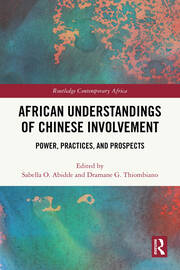
1st Edition
African Understandings of Chinese Involvement Power, Practices, and Prospects
Chapter 1: Introduction: China and the Chinese in Africa: An African Perspective
Sabella O. Abidde and Dramane G. Thiombiano
SECTION I: WHAT MANNER OF COOPERATION?
Chapter 2: The (Re)making of Empire: Africa in the Age of Chinese Expansion
Yimovie Sakue-Collins
Chapter 3: China-Africa Relations: Beyond the Exploiter-Exploited Narratives in Djibouti, Kenya, and Nigeria
Agnes Behr and Babatunde Oyateru
Chapter 4: China and Africa: A New Nexus Based on South-South Cooperation or Neocolonialism
Sandra Ochieng’-Springer
Chapter 5: China in Zimbabwe: The Optimists, Cautionists, and Radicals?
Kudakwashe Chirambwi
Chapter 6: Needs-Driven China-Nigeria Relations: A Game of Two Unevens
Tunde Oseni and Oluwatosin Olusola Adesina
SECTION II: ECONOMIC CONDITIONS
Chapter 7: Inducement or Strategic Partnership: Interrogating China-Nigeria Bilateral Relations
Idowu Johnson and Daniel Godwin
Chapter 8: Regime Security or Human Security? The Nexus between China’s Economic Activities and Peace and Security in Zimbabwe
Enock Ndawana and Kumbirai C. Ngwaru
Chapter 9: Political Economy of China in Africa
Gbensuglo Alidu Bukari
Chapter 10: The ‘Look East Policy’ and Debt Financing: A Political Economy Analysis of Sino-Zimbabwe Debt Relations
Vincent Chakunda and Arthur Fidelis Chikerema
Chapter 11: China and Domestic West African Country Markets: Emerging Issues, Trends and Challenges
Olawale Yemisi
SECTION III: AGENCY, POLITICS, AND PROPOSITIONS
Chapter 12: The Media, Civil Society Organizations and the Question of Agency in Sino-African Relations: The Perception of Ghanaians
Isaac Nunoo and Justice Kwabena Atenka
Chapter 13: China’s Win-Win Cooeration in Uganda: A Reality or Rhetoric
Joel Odota and Richard Mbayo
Chapter 14: Transitioning from a 'No-Win' Scenario to a 'Win-Win' Proposition: The Democratic Republic of Congo’s Efforts to Renegotiate the Sicomines Agreement with China
Hellen Adogo
Chapter 15: International Cooperation and National Diffraction: The Institutional Challenges of Moroccan Power in the Face of the Belt and Road Initiative
Adam Laroussi
Biography
Sabella O. Abidde is a professor of political science and a member of the graduate faculty at Alabama State University. He holds a B.A. in international relations and an M.Sc. in educational administration from Saint Cloud State University, Minnesota; an M.A. in political science from Minnesota State University, Mankato; and a Ph.D. in African Studies, World Affairs, Public Policy, and Development Studies from Howard University. He has edited and co-edited several volumes, including Xenophobia and Nativism in Africa, Latin America, and the Caribbean (Routledge, 2023). Professor Abidde is a lifetime member of the African Studies and Research Forum (ASRF), the American Association for Chinese Studies (AACS), the Midwest Association for Latin American Studies (MALAS), and the Association of Global South Studies (AGSS), where he currently serves as its vice president/president-elect. He is a 2023 MOFA Taiwan Fellow and a 2024 Carnegie African Diaspora Fellow.
Dramane G. Thiombiano is from Burkina Faso, West Africa. He is an assistant professor at the National Yun-Lin University of Science and Technology. He previously taught in the International Master Program in Asia-Pacific Affairs at National Sun Yat-sen University, Kaohsiung, Taiwan, where he earned his master’s degree (2010) and Ph.D. (2016). His research interests include entrepreneurship, emerging market analysis, China-Africa relations, Taiwan’s political economy, cross-strait relations, and Taiwan-Africa relations. His most recent publications include: The Beijing Consensus versus the Washington Consensus in Africa: Why Is the Chinese Model Gaining Ground in Africa? (Sun Yat-sen Journal of Humanities, 2016), The Impact of China on the Agency and Negotiating Power of African Countries: Cases of Angola and Niger (African Journal of Political Science and International Relations, 2020); and A Sentiment Based Text Analysis of the Perception of Chinese Infrastructure Development in Africa (International Journal of Social Science Studies, 2022).
“This volume examines contemporary Sino-African relations, offering insights that move
beyond the narrow interpretations often presented by Western voices. This approach addresses many of the unanswered questions surrounding this complex relationship.”Victor Adetula, Professor of International Relations and Development Studies, University of Jos, Nigeria.
“This insightful volume offers a much-needed African perspective on the intricate dynamics of Sino-African relations. Through critical analysis and rich case studies, it challenges prevailing narratives and highlights Africa’s agency in shaping its future. It is a timely and thought-provoking contribution to the discourse on development and international cooperation.”
Kristina Kironska, Assistant Professor, Palacky University Olomouc, Co-Director, Central European Institute of Asian Studies.
“The varied perspectives embossed in the volume provide a nuanced exploration of the effects of Chinese policies and practices on African societies. This book is a valuable resource for academics, policymakers, and anyone interested in the intricate global affairs.”
Lawrence Mhandara, Senior International Relations Lecturer, University of Zimbabwe.
“A sharp and unflinching analysis that cuts through the myth that greater investment or foreign assistance is the antidote to Africa’s ongoing struggles. The authors explain why the salvation of Africa lies not in the quality or choice of global partners but in how Africans choose and monitor their leaders at the local, state, and national levels.”
Joagni Pare, Proprietor Educational Institution & B2B White Paper Specialist & Marketing Consultant).
