




1st Edition
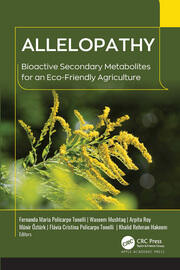
Allelopathy Bioactive Secondary Metabolites for an Eco-Friendly Agriculture
1. Synthetic Pesticides and Environmental Pollution
Munir Ozturk, Alvina Gul, Noor Ul Ain Malik, Oushna Fajer, Attia Rubab Khalid, Volkan Altay, and Bengu Turkyilmaz Unal
2. Environmental Health: An Urgent Matter
Munir Ozturk, Aneeqa Hanif, Alvina Gul, and Volkan Altay
3. Brief History of Allelopathy
Fernanda Maria Policarpo Tonelli
4. Allelopathy Induction in Crops by Natural Selection
Monica Butnariu
5. Crop Allelopathy’s Relationship with Herbivory
Bengu Turkyilmaz Unal, Huseyin Turker, and Munir Ozturk
6. Main Pathways Involved in the Production of Allelochemicals
Monica Butnariu and Niranjan Koirala
7. Plant Breeding in Allelopathy
Emmanuel Chikalipa
8. Allelopathy and Green Agriculture
Dnyaneshwar Lokhande, Vikram Jadhav, and Jayraj Aher
9. Plant-Based Anthelmintic: A New Trend to Combat Helminth Infections
Muhammad Zeeshan, Muhammad Sohail Sajid, Mahvish Maqbool, Ali Ahmad, Zubair Aslam, Korkmaz Bellitürk, and Muhammad Ibrahim
10. The Role of Microorganisms in Allelopathy
Sankara Rao Miditana, Saivenkatesh Korlam, and S. Padmavathi
11. Allelochemicals Against Phytopathogens
Iqra Siddique, Alvina Gul, Bengu Turkyilmaz Unal, and Munir Ozturk
12. Boost in Allelopathy: A Genetic Engineering Approach
Madhu Raina and Gulzar A. Rather
13. In Silico Approaches for Green Agriculture
Hajira Imran, Alvina Gul, Bengu Turkyilmaz Unal, and Munir Ozturk
14. The Allelopathic Potential of Green Propolis
Vitória De Oliveira Lourenço, Flávia Cristina Policarpo Tonelli, Fernanda Maria Policarpo Tonelli, Geicielly Da Costa Pinto, João Vitor Expedito Nunes, Vinícius Marx Silva Delgado, and Joaquim Maurício Duarte Almeida
15. Leucaena leucocephala: An Invasive Plant and Source of Allelochemicals in Brazil
Geicielly Da Costa Pinto, Vitória De Oliveira Lourenço, Fernanda Maria Policarpo Tonelli, Vinicius Marx Silva Delgado, and Flávia Cristina Policarpo Tonelli
16. Allelopathic Potential of Smilax brasiliensis Sprengel (Smilacaceae) Spec
Lucas Santos Azevedo, Luana Cristina Diniz Santos, Izabela Caputo Assis Silva, Thaís Paula Rodrigues Gonçalves, Ana Hortência Fonsêca Castro, and Luciana Alves Rodrigues Dos Santos Lima
17. Allelopathic Potential of Solanum lycocarpum A. St. Hill. (Solanaceae) Species
Luciana Alves Rodrigues Dos Santos Lima, Luana Cristina Diniz Santos, Lucas Santos Azevedo, Izabela Caputo Assis Silva, and Thaís Paula Rodrigues Gonçalves
Biography
Fernanda Maria Policarpo Tonelli, PhD, is an Assistant Professor at Federal University of São João del Rei, Brazil. Specializing in biotechnology/molecular biology, she has been studying nanomaterials applications in plants and the allelopathic potential of secondary metabolites, resulting in several granted patents. She has published books, book chapters, and scientific articles. She has been recognized with various awards, including For Women in Science Brazil (awarded by L'Oreal Brasil, UNESCO in Brazil, and Brazilian Academy of Sciences) and Under 30 Brazil (Forbes).
Waseem Mushtaq, PhD, is a postdoctoral researcher at Liege University, Belgium, focusing on weed management through the application of allelopathy, green chemistry, and omics technology. Dr Mushtaq has published several book chapters and numerous research papers in journals of national and international repute. He co-authored the book Allelopathy: Potential for Green Agriculture.
Arpita Roy, PhD, is an Assistant Professor in the School of Engineering and Technology at Sharda University, India. Her areas of interest include plant biotechnology, environmental biotechnology, green nanoparticle synthesis, and microbiology. She has published peer-reviewed papers as well as several books, and has presented papers at national and international conferences. She has been listed in the top 2% of scientists in the world (per Stanford University and Elsevier for 2022, 2023, and 2024.
Münir Öztürk, PhD, DSc, is Vice President of the Islamic World Academy of Sciences. He was formerly Chairman of the Botany Department and Founding Director of the Centre for Environmental Studies at Ege University, Turkey. He was also a consultant fellow at the Faculty of Forestry at the Universiti Putra Malaysia and a distinguished visiting scientist at the International Center for Chemical and Biological Sciences at Karachi University, Pakistan. He has published many books, book chapters, and papers in journals.
Flávia Cristina Policarpo Tonelli is a PhD student, currently researching bioactive phytochemicals present in the natural product green propolis. She has published four scientific articles and 15 book chapters. She has served as a reviewer for reputed journals.
Khalid Rehman Hakeem, PhD, is Professor at King Abdulaziz University, Saudi Arabia, involved with international research with various government organizations. A prolific author and editor, he has published many research papers, book chapters, and edited books. Dr Hakeem serves as a journal editorial board member and reviewer, and an advisory board member of Cambridge Scholars Publishing, UK.
